
Sofia Bulgaria Travel Guide 2026: the biggest practical change for visitors is currency — Bulgaria adopted the euro on January 1, 2026. The Bulgarian lev has not been legal tender since February 1, 2026. You need euros in Sofia now — not lev, not a currency exchange, not a BGN ATM. Just euros.
The impact on prices was minimal. The ECB tracked actual consumer prices through January and February 2026: month-on-month inflation rose 0.6% in January — the “euro rounding effect” that Bulgarians feared largely didn’t materialise. Sofia’s public transport actually got slightly cheaper after rounding. Coffee prices saw a minor 5-8% increase. Sofia is still one of Europe’s cheapest capital cities.
Budget: €30-50/day. Metro: €0.80 per journey. A local restaurant meal: €3-5.
Prices confirmed from grandroyaltravel (April 2026), ECB blog (April 2026), and multiple sources, May 2026.
Is Sofia Still Cheap After Adopting the Euro?
Yes. The fixed conversion rate of 1 EUR = 1.95583 BGN was unchanged for years before adoption — the lev was pegged to the euro for decades. So the “adoption” was a formal step, not a repricing event.
The ECB published a blog post on April 9, 2026 specifically examining the price impact. Key findings: inflation rose 0.6% month-on-month in January 2026, compared to a typical January increase of around 0.2%. The additional 0.4% is attributed to rounding and one-off changeover costs in the services sector. By February 2026, year-on-year inflation had returned to 2.1% — comparable to the eurozone average.
Sofia public transport fares went down slightly after the mandatory rounding to euro cents. The metro single ticket is €0.80 (was 1.60 BGN, which converts to €0.818 — rounded down). Some coffee prices went up by 10-20 cents as cafés rounded up to the nearest clean euro figure.
The underlying cost of Sofia has not changed. Budget travelers spend €30-50/day covering accommodation, meals, and city transport. Mid-range travelers spend €60-100/day. That puts Sofia in the same tier as Sarajevo, Belgrade, and Tirana — significantly below Prague, Warsaw, or any Western European ca
Sofia Bulgaria Travel Guide 2026 – Currency Practical Notes
Since February 1, 2026: euros only. The lev is no longer accepted anywhere in Bulgaria. Banks exchanged old lev notes to euros free of charge for six months from January 2026 — if you have leftover lev from a previous visit, exchange them at a Bulgarian commercial bank by July 2026.
Prices are currently displayed in both EUR and BGN (this dual-display requirement runs from August 2025 to August 2026). After August 2026, BGN prices disappear from signs entirely. For now, you may see both numbers on menus and museum entry boards — the euro figure is the one you pay.
What to Do in Sofia
The Serdica Roman Complex
The most underexplained sight in the city. Under the streets adjacent to Serdika metro station runs a free walkable underground passage through the ruins of ancient Serdica — Sofia’s Roman predecessor from the 2nd-4th century AD. The metro station was specifically designed around the ruins: the platforms include glass floor sections looking down into the excavations, and the passage itself has original Roman street surfaces, column bases, mosaic floors, and a baptistery visible at close range.
Walk from the Serdika station exit on the west side toward the underpass. The passage connects under the main boulevard and takes about 20 minutes to walk thoroughly. Free. No ticket, no queue.
This is not simply “ruins near the metro.” It is a walkable Roman streetscape — the difference between a photograph of ruins and standing next to a mosaic floor that was laid in the 4th century and has been in the ground ever since.
Time: 20-30 minutes. Cost: Free.
Alexander Nevsky Cathedral
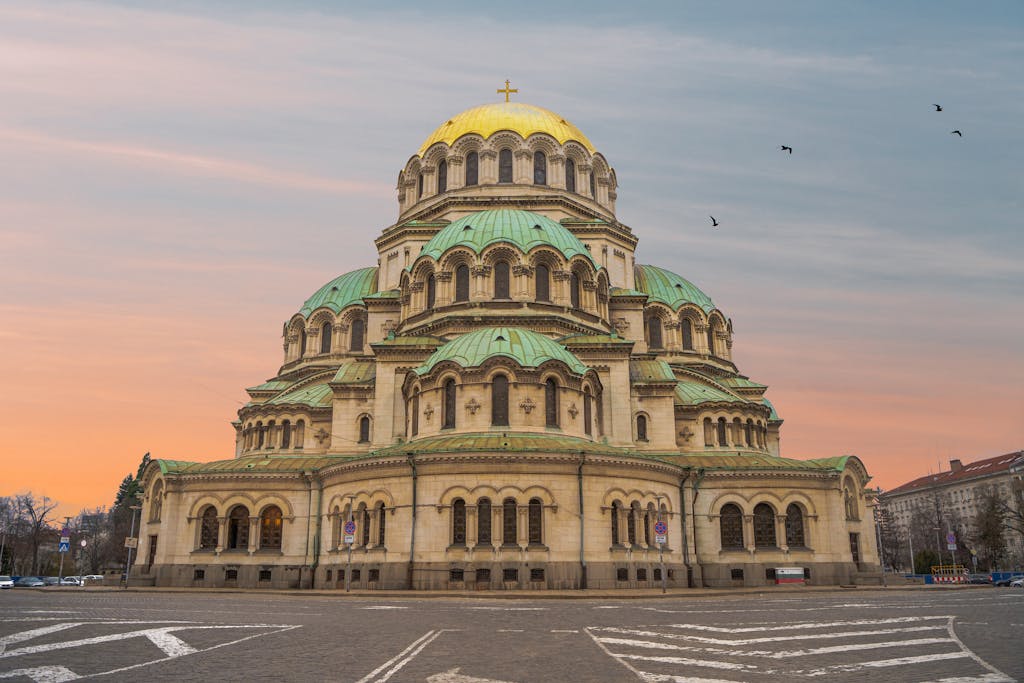
One of the largest Orthodox cathedrals in the world, built between 1882 and 1912 to honour the roughly 200,000 Russian soldiers who died in the Russo-Turkish War of Liberation (1877-78). The interior: gold-painted domes, marble columns, chandeliers, and frescoes. The crypt below houses Bulgaria’s national collection of Orthodox icons — separately ticketed but worth the supplement.
Come in the morning for the best light through the upper windows. The exterior is as significant as the interior — the golden domes are visible from across the city.
Time: 45-60 minutes. Cost: Cathedral free; crypt/icon museum ticketed (~€3-5).
Banya Bashi Mosque and the Mineral Baths Area
Built in 1576, Banya Bashi is Sofia’s only functioning mosque and one of the oldest buildings in the city. It was built over natural hot springs — on cold mornings, steam is sometimes visible rising from the ground in the surrounding area. The mosque is open to non-Muslim visitors outside prayer times. During Friday midday prayers, the mosque closes to non-Muslim visitors. Time your visit accordingly.
Directly opposite: the Central Mineral Baths building, a grand Art Nouveau structure now housing the Sofia History Museum. The same hot spring system that feeds the mosque historically supplied the public baths. Entry to the museum: ~€3.
Walk this area early in the morning when both buildings are quiet and the surrounding market stalls are just setting up.
Time: 30-45 minutes. Cost: Mosque free; museum ~€3.
Vitosha Boulevard and the City Walk
Sofia’s main pedestrian street runs from the National Palace of Culture (NDK, a 1981 Brutalist landmark worth seeing for the architecture alone) northward through the city centre. The boulevard has cafés, shops, and at the southern end on clear days, an unobstructed view of Mount Vitosha.
Walk north from NDK: past the Russian Church (St. Nicholas Church, an unexpected Art Nouveau Russian Orthodox building from 1914), through the shopping streets, to the Largo — the imposing ensemble of late-Stalinist buildings housing government departments, with the President’s building and the Changing of the Guard ceremony (daily at noon on the hour).
Time: 1-2 hours. Cost: Free.
Free Walking Tour
The Free Sofia Tour is one of the better free tours in Eastern Europe. Tip-based, English language, 2-3 hours covering the Largo, Soviet-era buildings, Serdica, the mineral baths area, and the religious buildings around the city centre.
Meeting point: Lion statues outside the Palace of Justice (Court of Justice building, near the Serdika metro station). The lion statues are directly in front of the main entrance. Times: Daily 11AM and 2PM. Weekends also 10AM.
Go on the first morning — it orients the city better than an hour of map-reading, and the guides are locals with specific knowledge of how Soviet planning shaped the urban fabric.
National History Museum
Not walkable from the centre — located in the former communist residence area about 20 minutes by taxi (€5-7). The collection is the strongest in Bulgaria: Thracian gold artifacts, prehistoric gold, medieval Bulgarian kingdom objects, Ottoman period, and ethnographic material.
Do not skip this for a second central-area café. The Thracian gold alone — necklaces, masks, and vessels from the 4th-5th century BC — is exceptional and requires about 1.5-2 hours to see properly.
Time: 2 hours. Cost: ~€3-5 entry. Getting there: Taxi from the centre, €5-7 each way. Worth it.
Boyana Church
Boyana Church is one of Sofia’s most important cultural sites.
It sits on the outskirts of the city near Vitosha Mountain and is UNESCO-listed because of its medieval frescoes. UNESCO describes the church as a three-part complex with frescoes painted in 1259 that form one of the most important collections of medieval paintings.
Boyana Church is not a huge site, but it is historically significant and worth adding if you like art, history, or religious architecture.
Best for: history, UNESCO sites, medieval art
Suggested time: 1–2 hours including transport
Image alt text: Boyana Church UNESCO site near Sofia Bulgaria
Vitosha Mountain
One of Sofia’s biggest advantages is how close it is to the mountains.
Vitosha Mountain is visible from the city and can be visited as a half-day or full-day escape. Depending on the season, travelers go for hiking, viewpoints, snow activities, or simply cooler air outside the city.
This is one of the reasons Sofia works well in 2026: it is not only a city break. You can add nature without needing a complicated itinerary.
Best for: hiking, views, fresh air, easy nature escape
Suggested time: half day or full day
Image alt text: Vitosha Mountain view near Sofia Bulgaria
Sofia’s Cafés and Food Scene
Sofia has a better café and food scene than many first-time visitors expect.
You can find bakeries, casual Bulgarian restaurants, brunch cafés, wine bars, and simple local places where prices remain reasonable. The food scene is not as famous as Budapest or Krakow, but it is one of the city’s quiet strengths.
Try:
| Food / Drink | What It Is |
|---|---|
| Banitsa | Flaky pastry often filled with cheese |
| Shopska salad | Tomato, cucumber, pepper, onion, and grated white cheese |
| Kebapche | Grilled minced meat |
| Tarator | Cold yogurt and cucumber soup |
| Bulgarian yogurt | Thick yogurt, often eaten plain or with honey |
| Local wine | Bulgaria has a long wine tradition |
For a budget city break, Sofia is easy because you can eat well without planning every meal around cost.
National Palace of Culture Area
The National Palace of Culture area is useful for walking, parks, events, and seeing a more modern side of Sofia.
It is not as historic as the center, but it helps you understand the city beyond churches and ruins. The surrounding park and public spaces are good for a relaxed walk, especially in the evening.
Day Trips from Sofia
Rila Monastery (UNESCO, highly recommended)
Bulgaria’s most significant Orthodox monastery, 2 hours south of Sofia. Founded in the 10th century, rebuilt in the 19th. The main courtyard is covered in frescoed arches — 1,200 square metres of painted scenes from floor to ceiling on every wall and pillar visible from the courtyard. The contrast between the ornate painted interior and the forested mountain setting is the specific thing photographs don’t fully capture.
Getting there: Guided day tour from Sofia (~€30-45/person from GetYourGuide), public bus from Sofia Central Bus Station (requires a change at Rila town), or rental car.
Time: Full day minimum. Add the Ossi Charnel House nearby — a bone ossuary with skulls and bones in geometric patterns on the walls, built to house the remains of monks.
Plovdiv (half-day or overnight)
1.5-2 hours by bus from Sofia. Europe’s oldest continuously inhabited city — occupied since approximately 6,000 BC. The Old Town has National Revival-era painted houses on cobblestone hills above a working Roman amphitheatre that still hosts summer concerts. 28% cheaper than Sofia for accommodation and food.
Bus from Sofia Central Bus Station: ~€8, 2 hours.
Full Eastern Europe context: Eastern Europe Travel Guide 2026
Sofia Costs in 2026
| Item | Price (EUR) |
|---|---|
| Metro single ticket | €0.80 |
| Metro day pass | ~€2.65 |
| Budget meal (local restaurant) | €3-5 |
| Coffee | €1-1.50 |
| Beer | €2-3 |
| Mid-range restaurant meal | €8-15 |
| Budget hostel dorm | €15-20/night |
| Budget hotel | €30-50/night |
| Alexander Nevsky Cathedral | Free |
| Serdica Roman complex | Free |
| National History Museum | ~€3-5 |
| Free Sofia Tour | Free (tip-based) |
| Rila Monastery guided day trip | ~€30-45 |
| Taxi to National History Museum | ~€5-7 |
| Bus to Plovdiv | ~€8 |
Best Time to Visit
May-June and September-October: best balance of weather, low crowds, and prices. Sofia is entirely navigable on foot in those months and accommodation is 20-30% cheaper than July-August.
July-August: hot (25-30°C regularly), summer concert season at the Roman theatre and outdoor venues, Vitosha mountain hiking and swimming in mountain lakes. Busier and marginally more expensive.
Winter: cold (-5 to 5°C), good skiing at Vitosha (25 minutes from the city centre by cable car) and Borovets (1 hour). Sofia is an exceptional winter city-break — cheap, easy to navigate on foot in good shoes, almost no tourist crowds outside the museums.
FAQ
Has Bulgaria adopted the euro?
Yes. Bulgaria adopted the euro on January 1, 2026, becoming the 21st member of the euro area. The fixed conversion rate is €1 = 1.95583 BGN, the same rate at which the lev had long been pegged to the euro. The one-month dual-circulation period for cash payments ended on January 31, 2026, so the euro is now the currency travellers should use in Sofia. Check the official European Commission Bulgaria and the euro page or the ECB Bulgaria euro changeover page before travel.
Is Sofia still cheap after adopting the euro?
Yes. Sofia remains one of the cheapest capital cities in Europe, even after Bulgaria’s euro adoption. Budget travellers can still plan around €30-50 per day with public transport, casual food, and low-cost sightseeing. For current transport fares, check the official Sofia Urban Mobility Centre, and for general visitor planning use the official Visit Sofia tourism site.
How many days do you need in Sofia?
Two to three days covers Sofia’s main sights without rushing: the Serdica Roman complex, Alexander Nevsky Cathedral, the Banya Bashi area, Vitosha Boulevard, a free walking tour, and the National History Museum. Add a third day if you want to visit Rila Monastery or Plovdiv. Sofia is compact enough that two nights gives most travellers a complete introduction.
What is Sofia known for?
Sofia is known for Alexander Nevsky Cathedral, one of the largest Orthodox cathedrals in the world; the Serdica Roman complex under the city centre; Banya Bashi Mosque, built over natural hot springs; and Mount Vitosha rising behind the city. Since January 2026, Sofia is also the first Bulgarian capital city where travellers use euros instead of the Bulgarian lev.
Is there a free walking tour in Sofia?
Yes. Free Sofia Tour runs tip-based English walking tours from the city centre, usually starting near the Palace of Justice. The route covers the central sights, religious buildings, Soviet-era architecture, and the Serdica area. Check the official tour page for the current meeting point and schedule before going.
Related articles:
Best Cheap Hostels in Eastern Europe 2026
Best Budget Hotels in Sofia 2026
Eastern Europe Travel Guide 2026
Eastern Europe Summer Travel Deals 2026
Created by WanderGuide Travel Desk
Practical travel planning, built for independent travellers.
WanderGuide articles are created using official tourism and transport sources, route research, hotel-area checks, cost comparisons, local travel context and practical itinerary planning for first-time and budget-conscious travellers.
Read our editorial approach