
Sarajevo sits in a mountain bowl, and the countryside around it is extraordinary. Within two hours in most directions, you can reach Ottoman bridges, medieval fortresses, mountain villages, and waterfalls. But the real question is how to get there — because most of the best destinations require either a rental car or a guided tour. Only Mostar is genuinely accessible on public transport as a full day trip.
That is why this Day Trips from Sarajevo 2026 guide focuses less on generic inspiration and more on practical route planning. It classifies each trip by how you can actually reach it, gives the specific bus station address and departure tips, and flags the operational details that make the difference between a good day and a wasted one.
Transport prices confirmed from multiple sources including sarajevodaytrips.com and thingstodoinsarajevo.com, May 2026. BAM:EUR fixed ~2:1.
Day Trips from Sarajevo 2026: Quick Reference
| Day trip | By public transport? | Best approach | Full day? |
|---|---|---|---|
| Mostar | Yes (bus/train) | Bus or guided tour | Yes |
| Kravica Waterfalls | No | Tour or car | Half day (add to Mostar) |
| Blagaj Tekija | From Mostar yes (bus/taxi) | Add to Mostar | 1-2 hours |
| Lukomir Village | No | Guided tour | Full day |
| Vrelo Bosne | Yes (tram + walk) | Self-guided | Half day |
| Jajce | Bus but limited | Guided or car | Full day |
| Srebrenica | Organised tour only | Guided tour | Full day |
One day, no car: Mostar by bus. One day, maximum landscape: Lukomir hike (April-October, tour). Half day from Sarajevo: Vrelo Bosne. Most visits combine with Mostar: Kravica Waterfalls + Blagaj Tekija.
1. Mostar + Kravica + Blagaj — The Main Day Trip
The most popular day trip from Sarajevo, and the right first choice. Mostar’s Stari Most (Old Bridge), Kravica Waterfalls, and Blagaj Tekija together constitute one of the stronger single-day itineraries in the Balkans. All three are in southern Herzegovina, reachable in a logical route from Sarajevo and back.
Getting There by Bus
Station: Autobuska stanica Sarajevo, Put života 8 — this is not the station most people imagine from Google Maps of central Sarajevo. Confirm the address before you leave your accommodation. Most visitors who miss their bus do so because they went to the wrong station entrance or wrong part of the building.
Operators: Centrotrans, Globtour, Autoprevoz, Globus Turist — approximately 18 buses daily to Mostar. Journey: 2.5-3 hours. Price: 16-35 KM (~€8-18) depending on operator and booking method. Recommended departure: The 7:00 AM Autoprevoz bus gives you the most time in Mostar and at the waterfall stops. Weekend buses fill up — buy your ticket at the station the day before if traveling Saturday or Sunday. Seating: Sit on the driver’s side for the Neretva canyon views. The road follows the river through a narrow valley and the driver’s-side window is where the views are. Villages tucked into limestone cliff faces, roadside stalls selling honey and rakija — this is one of the more scenic bus journeys in the region.
Return: Last buses back to Sarajevo from Mostar typically depart 5-7PM. Confirm at the Mostar bus station on arrival.
Getting There by Train
A scenic alternative. The train from Sarajevo to Mostar follows the Neretva canyon — one of Bosnia’s more beautiful rail routes. Fewer departures than bus (1-2 per day), slower journey, but worth it if the timetable works. Check current schedules at the Sarajevo train station or hbzm.ba before travel.
Stari Most: What to Know
Built in 1566 by Ottoman architect Mimar Hayruddin. Destroyed by artillery in November 1993 during the Bosnian War. Rebuilt and reopened in 2004. UNESCO World Heritage Site since 2005.
The divers: The Mostarski Ikari club has been jumping from Stari Most since 1664 — predating the bridge’s destruction and rebuilding. The jump is 24 metres into the Neretva. In summer they stand on the arch, collect money from the crowd, and jump when they have enough. Do not attempt this yourself.
Best photo: Climb the Koski Mehmed Pasha minaret on the east side of the river. Entry ~€6. From the top the full arch of the bridge over the emerald Neretva is visible — the photograph that represents Mostar everywhere is taken from approximately this angle. Worth the €6 and the climb.
In July and August Mostar reaches 35-40°C. Bring water. Arrive early.
Kravica Waterfalls
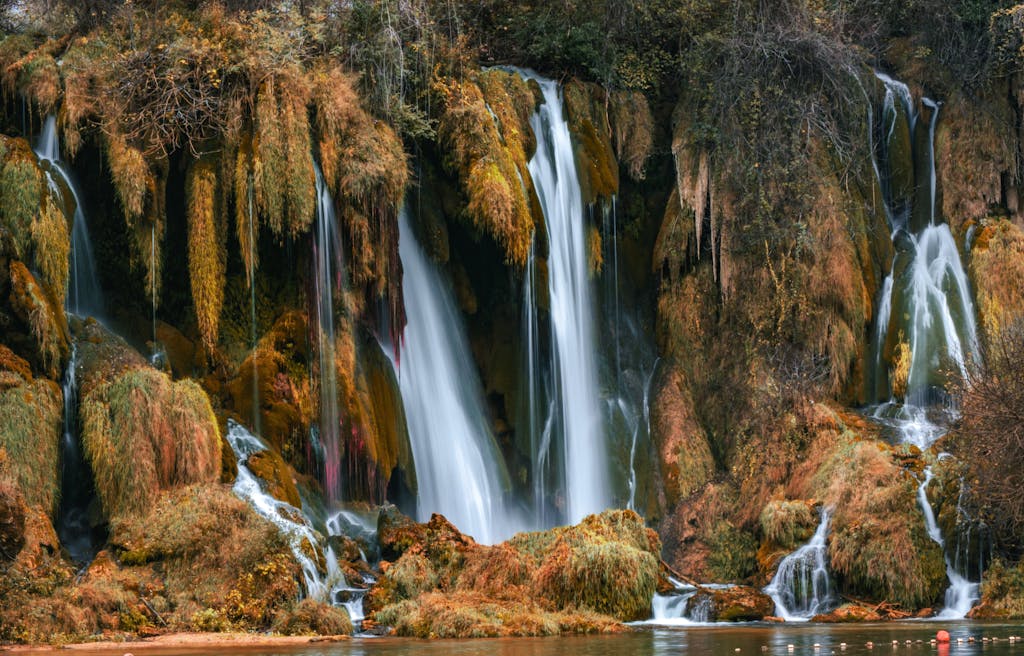
~45-50 minutes from Mostar by taxi (~25-35 KM) or included in guided tours. A 25-metre waterfall dropping into a turquoise travertine pool, surrounded by fig trees growing from the rock. Swimming is possible in summer.
Time it right: Visit Kravica before 11AM. Tour buses from Dubrovnik and Split arrive throughout the late morning — after 11AM the pool area fills quickly. If combining Kravica and Mostar in one day, go to Kravica first, arrive in Mostar for lunch. The afternoon light on the bridge is better anyway, and the divers are more active in the afternoon.
Bring water shoes: the pool bottom is smooth limestone and gets slippery with moss.
Blagaj Tekija
A 16th-century dervish monastery built at the source of the Buna river, 12km from Mostar. The Buna emerges directly from a cliff face and the monastery is built into the rock above the spring — the setting is worth the detour. From Mostar: local bus #6 (~2 USD) or taxi (~15 USD).
Mostar Day Trip: Guided vs Independent
Independent (bus): Works if you want Mostar itself — the old town, the bridge, the bazaar, one mosque. 5-6 hours in Mostar from a 7AM departure. Not enough to add Kravica and Blagaj independently (no public transport between them without backtracking).
Guided tour (from ~€70): Gives you Kravica + Počitelj + Blagaj + Mostar in a logical order with hotel pickup. Worth it if you want the full Herzegovina day. sarajevodaytrips.com, Funky Tours, and GetYourGuide all run this route.
2. Lukomir Village and Rakitnica Canyon
Bosnia’s highest inhabited village sits at 1,495 metres on the Bjelašnica mountain plateau, 1.5 hours from Sarajevo. Stone houses with cherry-wood roofs. Shepherds. Wool craftswomen in traditional dress. On the village edge: the Rakitnica Canyon drops 800 metres to the river below, and in some sections the canyon walls are barely a metre apart.
Practical reality: Lukomir is not accessible by public transport. The road is partly gravel and mountain-grade. Without a car, you need a guided tour.
Tours: Funky Tours, Meet Bosnia Tours, and Green Visions all run Lukomir guided day trips from Sarajevo (from ~€40-60 per person). The Viator-listed Lukomir Highland Village Hike has 326 reviews. Departure point: usually from central Sarajevo, some with hotel pickup.
Season: May to October. The village is at high altitude and the access road can be closed in winter for months — the village is effectively cut off from the outside world during heavy snow periods. Do not plan a Lukomir visit between November and April without confirming road access.
No ATM in the village. Bring cash — local women sell handmade wool crafts for 20-30 USD that are worth buying and hard to find elsewhere.
Hike option: The classic route hikes from Umoljani to Lukomir and back through the Rakitnica Canyon ridge — 12-16km roundtrip. The Peruce Waterfall (~40m) is on the return route. A full day minimum.
This is the day trip for travelers who want to see Bosnia beyond the Ottoman history. The mountain landscape is completely different from Baščaršija and nothing about it feels like a museum.
3. Vrelo Bosne (Half Day)
The spring source of the Bosna river, 12km southwest of Sarajevo. A natural park where crystal-clear water emerges from underground through a series of springs and channels, willows hanging over the banks, swans on the canals, a 3km avenue of plane trees. Horse-drawn carriages offer rides through the park.
Free to enter. Half-day maximum — the park is pleasant but not expansive enough for a full day.
Getting there: Tram 3 from Sarajevo centre to the Ilidža terminus, then a short walk or horse carriage into the park. No car needed.
Best paired with: An afternoon back in Sarajevo for the Tunnel of Hope or Yellow Fortress, making a complete half-day nature, half-day history day.
4. Jajce
A medieval town 145km north of Sarajevo with a 20-metre waterfall in the town centre where the Pliva drops into the Vrbas canyon. A medieval fortress above the rooftops. Wooden water mills on the Pliva lakes. The town where the second session of AVNOJ (the Anti-Fascist Council that governed Yugoslavia) was held in 1943.
Transport: Buses run from Sarajevo but are limited in frequency — the journey is 2.5-3 hours. Getting back on the same day requires catching the last afternoon service, which limits time in Jajce. Most travelers either rent a car or combine Jajce with nearby Travnik (former Ottoman capital) as an organised tour.
If you have a car: Jajce + Travnik + a detour through the Pliva canyon is one of the better drives in Bosnia.
5. Srebrenica Memorial
A full day, guided tour. Srebrenica is 115km from Sarajevo and the Memorial Center Potočari documents the 1995 Srebrenica genocide — the worst atrocity on European soil since World War II.
This is not a tourism attraction in the conventional sense. It’s a historical responsibility site. The Srebrenica Memorial Museum opened in 2023 in the former battery factory where more than 8,000 Bosniak men and boys were killed.
Book: Through a guided tour from Sarajevo — multiple operators offer this as a full-day historical excursion. Not accessible independently on public transport in a practical day-trip timeframe. Emotionally demanding. Go with sufficient time and preparation.
Sarajevo context: Is Sarajevo Worth Visiting in 2026?
How Many Days Do You Need for Day Trips from Sarajevo?
3 nights in Sarajevo comfortably covers one full day trip (Mostar with Kravica and Blagaj) and one half-day trip (Vrelo Bosne). 4 nights adds Lukomir or Jajce. For Srebrenica, add a specific day — it shouldn’t be rushed or squeezed between other things.
If your itinerary is tight: Mostar is the non-negotiable. Every other day trip is optional by comparison.
FAQ
Is Sarajevo better than Belgrade?
It depends on the traveller. Sarajevo is better for history, culture, Ottoman atmosphere, and compact walkable intensity. Belgrade is better for nightlife, city scale, variety, and a bigger urban experience. The Post Office City Costs Barometer 2026 ranks Sarajevo as Europe’s best-value city break, while Belgrade also sits among the cheapest major city breaks in Europe. If you have 5+ days, doing both is the strongest option.
Is Sarajevo cheaper than Belgrade?
Marginally. The Post Office City Costs Barometer 2026 puts Sarajevo at £248 for a 48-hour city break, with Belgrade also ranked in Europe’s top-value group. However, Belgrade public transport has been free since January 1, 2025, covering city and suburban buses, trams, trolleybuses, and the BG Train. That makes the real cost gap narrower than the headline city-break figures suggest.
Can you visit both Sarajevo and Belgrade in one trip?
Yes. FlixBus runs between Sarajevo and Belgrade, with night buses also available on some schedules. A practical 5-day route is 2 nights in Belgrade, bus to Sarajevo, then 3 nights in Sarajevo. A 7-day version adds a Novi Sad day trip from Belgrade and a Mostar day trip from Sarajevo.
Which is better for nightlife: Sarajevo or Belgrade?
Belgrade, clearly. The city is known for splavovi floating river clubs on the Sava and Danube, the Savamala bar district, and an underground club scene. Start with the Tourist Organization of Belgrade nightlife guide for official nightlife context. Sarajevo has bars and a strong café culture, but it does not compete with Belgrade specifically for nightlife.
Which is better for history: Sarajevo or Belgrade?
Sarajevo is better for concentrated, emotionally powerful history. The Latin Bridge area, the Tunnel of Hope, the War Childhood Museum, and Baščaršija give Sarajevo more historically specific material per square kilometre than almost any European city. Belgrade has Kalemegdan Fortress and the Nikola Tesla Museum, but its major sights are more dispersed.
Related articles:
How to Travel Eastern Europe by Train in 2026
Is Sarajevo Worth Visiting in 2026?
Where to Stay in Sarajevo 2026
Eastern Europe Travel Guide 2026
Created by WanderGuide Travel Desk
Practical travel planning, built for independent travellers.
WanderGuide articles are created using official tourism and transport sources, route research, hotel-area checks, cost comparisons, local travel context and practical itinerary planning for first-time and budget-conscious travellers.
Read our editorial approach