
Two medieval walled cities on the Adriatic, two hours apart, both dealing with more visitors than their medieval architects planned for. Dubrovnik vs Kotor is a genuinely close comparison — and the 2026 pricing update changes it.
Starting in 2026, Dubrovnik’s city walls require a pre-booked time slot. The standalone ticket is €40. Kotor Fortress charges €15 — or nothing if you arrive before 8AM, when the ticket collectors usually have not started yet.
That is a 167% price difference for the experience most people visit both cities for. No existing comparison article has this 2026 update.
Cost: The Confirmed 2026 Comparison
| Item | Dubrovnik | Kotor |
|---|---|---|
| City walls / fortress entry | €40 (pre-booked required) | €15 (or free before 8AM) |
| Budget daily total | ~€65 | ~€41 |
| Mid-range daily total | ~€145 | ~€90 |
| Budget meal | ~€16 | ~€9 |
| Guesthouse/budget hotel (peak) | €80-120/night | €40-70/night |
| Beer near main square | €5-10 (€18 if not watching) | €3-5 |
| Tourist tax | €2.65/night peak | Standard |
Kotor runs approximately 35-40% cheaper across all categories. That gap has widened in 2026 with Dubrovnik’s walls price increase.
The Dubrovnik Walls Booking Change (2026)
Starting in 2026, walking the Dubrovnik city walls requires a pre-booked time slot. You cannot simply turn up and pay at the gate for a spontaneous walk.
Two options:
Option 1: Standalone walls ticket — €40. You get the walls and nothing else. This is the worst value option.
Option 2: Dubrovnik Pass — also €40. Includes the city walls plus the Rector’s Palace, Maritime Museum, and Franciscan Monastery, plus a 24-hour bus card. After purchasing the pass online, use the pass number to book your specific walls time slot.
The Dubrovnik Pass is clearly the right purchase — same price, significantly more included. The key is to pre-book the walls time slot in advance, especially in July and August when popular time slots sell out.
Source: defylife.com, May 4, 2026.
Crowds: Both Are Busy, But Differently
Dubrovnik receives up to 10,000 cruise passengers before 9AM on peak summer days. The Stradun — the main marble street — becomes what tripbase.com calls a “shared sauna” in July and August. It’s big enough to absorb crowds better than Kotor but never quiet in summer.
Kotor has a smaller footprint — 2km of old town streets — which means 2,000 cruise ship passengers feels proportionally more overwhelming. In July and August, the lanes are shoulder-to-shoulder from 10AM until ships leave.
The timing resolution for Kotor: Ships typically dock 10AM-6PM. After 6-7PM, the town empties. The evening Kotor — quiet cobblestones, cats between tables, the limestone cliffs above going dark, a kafana open with two other tables of locals — is architecturally equivalent to Dubrovnik at its best, with a fraction of the people.
The timing resolution for Dubrovnik: May and September. Dubrovnik with fewer visitors is genuinely exceptional — the city walls walk without queuing, the Stradun with space to look up at the buildings, the kayak around the walls at sunrise without a convoy of other kayaks. Go in shoulder season and the “overrated” complaint largely disappears.
Setting: Which Looks Better?
Both score 10/10 on photographic impact. They look different.
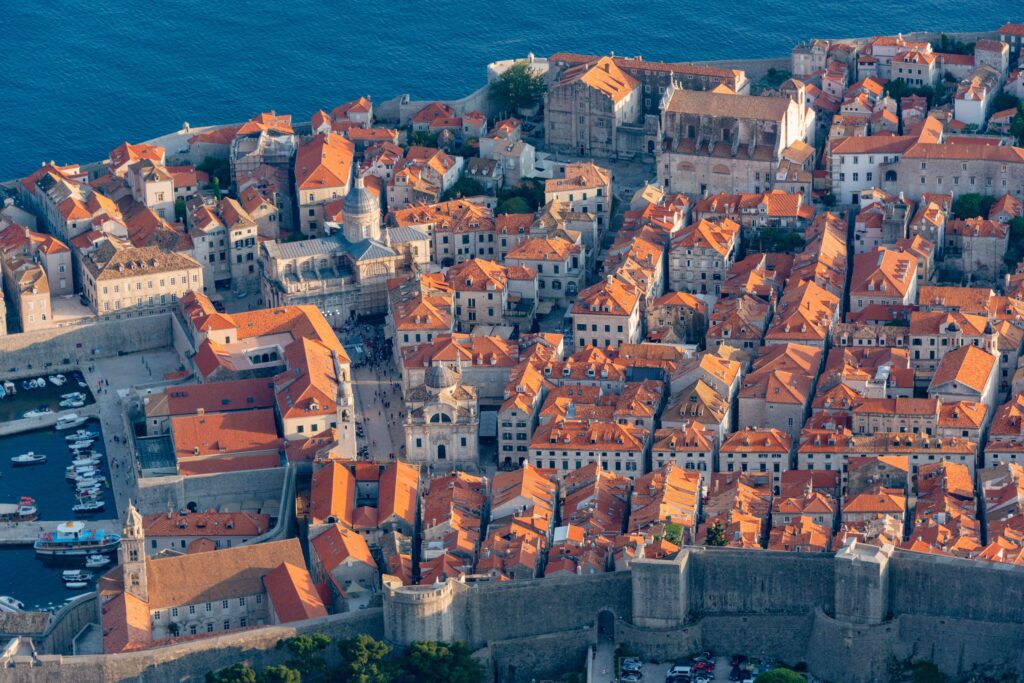
Dubrovnik: Open sea to the south and east, limestone Stradun running through the city, the island of Lokrum visible just offshore, city walls at sea level with Adriatic views in all directions. The setting is grand and horizontally expansive.
Kotor: The bay runs 28km inland, making it fjord-like. Limestone cliffs rise almost vertically immediately behind the old town. Mount Lovćen looms above. The setting is enclosed and vertically dramatic in a way Dubrovnik’s coastal panorama isn’t.
Most comparison guides give the setting verdict to Kotor. That’s defensible — the drama of cliffs directly above a medieval town is striking. But “better looking” is genuinely subjective here. What’s not subjective: the Kotor fortress hike gives you vertical height over the town that no Dubrovnik viewpoint matches.
Game of Thrones: Dubrovnik’s Specific Advantage
A meaningful portion of summer visitors come to Dubrovnik specifically for Game of Thrones filming locations. The Stradun was King’s Landing’s main street. The Jesuit Staircase is Cersei’s walk of atonement. The harbour area is Blackwater Bay. The city walls walk passes several recognisable locations.
The GoT experience is woven into the walls walk in a way that makes the €40 ticket slightly more defensible for fans. Kotor has no significant GoT presence.
For non-GoT visitors, this is irrelevant. For GoT fans, it’s a genuine point in Dubrovnik’s favour.
Beaches and Islands: Dubrovnik Wins
Dubrovnik has the island of Lokrum (15-minute ferry, nature reserve, no overnight stays allowed), plus Elaphiti Islands day trips (Šipan, Lopud, Koločep — accessible by ferry from Dubrovnik’s Gruž harbour). Beaches are available within or near the city (Banje, Lapad).
Kotor sits on the bay, not the open sea — the water is sheltered and swimmable but it’s bay swimming, not beach swimming. The nearest beaches are in Budva (30 minutes south) or on the Lustica Peninsula (45 minutes).
For a trip primarily about beaches and island variety, Dubrovnik is the stronger base. Kotor is the stronger base for the bay, the fortress, and access to Montenegro’s interior.
Can You Do Both? Yes — And Here’s the Routing
Kotor is 2 hours from Dubrovnik by car or taxi (€70-90). A bus runs for €10-15, taking 2-2.5 hours. Kotor is also 20 minutes from Tivat Airport and 2 hours from Dubrovnik Airport.
The practical routing: most UK and Western European visitors fly into Dubrovnik Airport, which has significantly more routes than Tivat. From Dubrovnik Airport, Kotor is already 2 hours south. Adding 2-3 nights in Kotor to a Dubrovnik trip requires one bus journey or taxi. The marginal cost and effort is very low.
The stronger version of the “Dubrovnik vs Kotor” decision is: start in Dubrovnik (3 nights), bus/taxi to Kotor (2-3 nights), continue into Montenegro’s interior or Albania. Both cities, one trip, with the Dubrovnik walls pre-booked before you leave home.
Suggested sequence: Dubrovnik first (more infrastructure, easier first arrival), Kotor second (quieter, more local in feel, better for decompressing after Dubrovnik’s intensity).
Continue south: Albania Travel Guide 2026 Full Kotor guide: Kotor Montenegro Guide 2026
The Verdict by Traveler Type
Choose Dubrovnik first if:
- This is your first Adriatic trip and you want the flagship experience
- Game of Thrones filming locations matter
- Island day trips (Lokrum, Elaphiti) are on the itinerary
- You want better flight connections (Dubrovnik Airport has more routes)
- You prefer a larger city with more restaurant and nightlife variety
Choose Kotor first if:
- Budget is a significant factor (35-40% cheaper across all categories)
- You want dramatic mountain-bay scenery over open-sea panoramas
- You’re combining with Montenegro’s interior (Durmitor, Ostrog, Skadar)
- You’ll visit in shoulder season (May-June, September) when both cities are at their best and the crowds gap narrows
- You’re building a Balkans arc: Kotor → Albania → back
Do both: The correct answer for anyone with 5+ days in the region.
FAQ
Is Kotor better than Dubrovnik?
Neither is objectively better. Kotor offers comparable medieval atmosphere at a lower cost, especially if you explore the old town early in the morning or after cruise ships leave. Dubrovnik is more famous, has better island access, and offers more activity variety. Most visitors with 5+ days should do both.
Is Kotor cheaper than Dubrovnik?
Yes, Kotor is usually significantly cheaper than Dubrovnik. Accommodation, meals, and sightseeing generally cost less in Kotor, while Dubrovnik has higher peak-season prices because of its global demand and cruise traffic. For Dubrovnik sightseeing, compare the standalone Dubrovnik City Walls ticket with the official Dubrovnik Pass before buying.
Do you need to pre-book Dubrovnik city walls in 2026?
You should book online in advance during peak season. Dubrovnik’s city walls are one of the city’s busiest attractions, and summer entry can be capacity-controlled or sell out at popular times. Check the official Dubrovnik City Walls ticket shop and the Dubrovnik Pass before visiting. If you plan to visit the walls plus museums or use local buses, the Dubrovnik Pass is often better value than a standalone walls ticket.
Can you do Dubrovnik and Kotor in one trip?
Yes. Dubrovnik and Kotor are close enough to combine easily, with the cross-border journey usually taking around two hours by car or bus, depending on border traffic. FlixBus runs Dubrovnik to Kotor services, and private transfers are also common. A practical route is 3 nights in Dubrovnik followed by 2-3 nights in Kotor.
Which is less crowded: Dubrovnik or Kotor?
Dubrovnik receives more visitors overall, but it is larger and absorbs crowds better. Kotor is smaller, so cruise arrivals can feel more intense inside the compact old town. Check the Port of Kotor cruise schedule if you want to avoid the busiest days. Both cities are dramatically calmer in May-June and September than in July-August.
Related articles:
- Kotor Montenegro Guide 2026
- Is Montenegro Worth Visiting in 2026?
- Eastern Europe Summer Travel Deals 2026
- Albania Travel Guide 2026
Created by WanderGuide Travel Desk
Practical travel planning, built for independent travellers.
WanderGuide articles are created using official tourism and transport sources, route research, hotel-area checks, cost comparisons, local travel context and practical itinerary planning for first-time and budget-conscious travellers.
Read our editorial approach