
Kotor old town is 2 kilometres of medieval lanes inside Venetian walls. In July and August, cruise ships dock at 10AM and unload thousands of passengers into those 2 kilometres. By 6-7PM, the ships leave. The old town empties. The evening version of Kotor — quiet cobblestones, cats moving between tables, the limestone cliffs turning gold above the rooftops — is genuinely different from the midday version.
That timing gap is the first thing worth knowing. Everything else follows from it.
Fortress walls entry: €15, charged 8AM-8PM in peak season. Before 8AM: no ticket collector, no queue, sunrise over the bay. Our Lady of the Rocks island in Perast: man-made, locals have been throwing rocks into the bay to expand it since 1452 — on July 22 every year they still do.
Prices confirmed from multiple sources, May 2026. Montenegro uses euros.
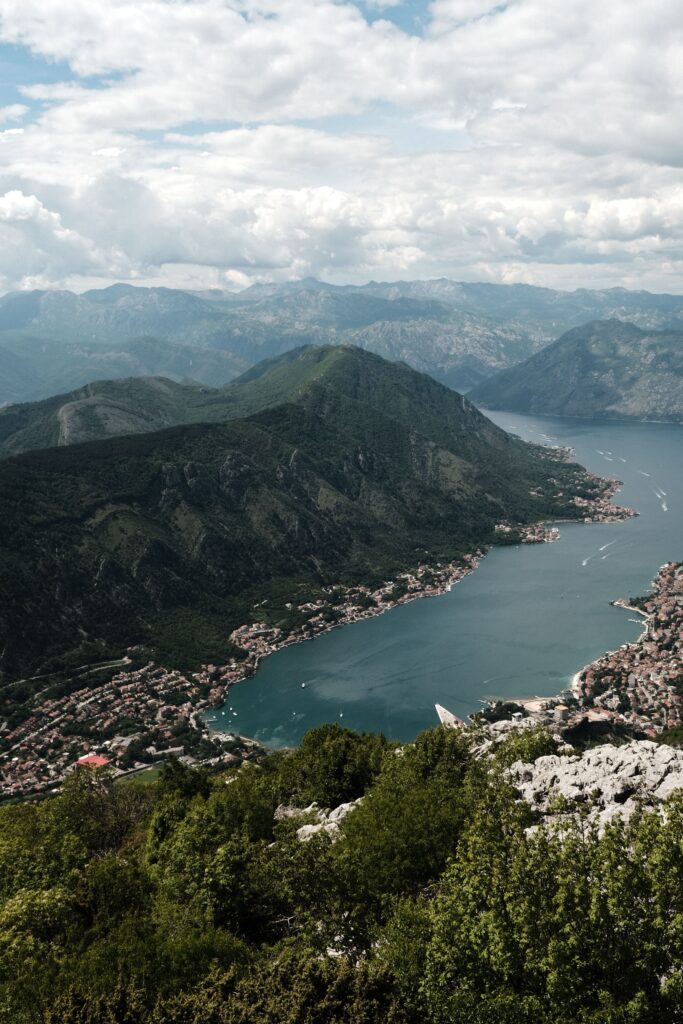
Kotor Bay Montenegro Guide 2026 – Is Kotor Worth Visiting?
Yes — specifically for the physical setting. The Bay of Kotor is sometimes called Europe’s southernmost fjord. It’s not technically a fjord (formed by glaciers, not the sea), but the visual experience is similar: limestone cliffs rising almost vertically from dark water, a medieval walled town at the base, mountains behind it. The bay runs 28 kilometres inland, which means the water is sheltered and calm, and the views from any elevation are extraordinary.
Kotor rewards visitors who time it correctly. In high summer with cruise ships in port, the old town is uncomfortably crowded. In the evening, in shoulder season (May-June, September-October), or at sunrise, it’s one of the more beautiful places on the Adriatic.
Things to Do in Kotor 2026: Fortress, Perast & Timing Tips
The Fortress Walls: What to Know Before Going
Entry and the Free Windows
Standard entry: €15 per person. Ticket collectors operate approximately 8AM to 8PM during peak season (April-October). The path is always accessible — the ticket booth is simply not staffed outside those hours.
Before 8AM: walk in without paying. No one stops you. The early morning advantage is real: temperatures are cooler, the light is golden over the bay, and you have the 1,350 steps to yourself. In July and August, the fortress fills up quickly after 9AM.
After 8PM: also free access. Worth it in midsummer when the light lingers past 8PM.
The Climb
1,350 steps to the San Giovanni summit at approximately 260-280 metres. The ascent takes 45 minutes to 1 hour depending on pace and fitness. The descent is around 30 minutes.
At approximately 650 steps, you reach the Church of Our Lady of Remedy — a 16th-century Catholic church built directly into the ramparts. The views from the church terrace are already significant: the entire old town visible below, the bay spreading out, the terracotta roofs in miniature. For visitors with limited fitness, this is a legitimate and satisfying turnaround point. You do not need to reach the summit for a worthwhile experience.
Push through the remaining 700 steps to the summit for the full panorama — the bay’s S-curves, the old town looking tiny, cruise ships from above.
What You’re Climbing
The Kotor fortifications started as an Illyrian hill fort, were expanded by the Byzantines, and were rebuilt extensively by the Venetians between the 15th and 18th centuries. During the Venetian period (1420-1797), Kotor was called “Cattaro.” The walls run 4.5 kilometres, reach up to 20 metres high and 16 metres thick, and the whole system is part of the UNESCO “Venetian Works of Defence” recognition alongside Bergamo and Peschiera del Garda.
The fortress is said to have never been taken by force — defending successfully against multiple Ottoman siege attempts. That claim is a point of local pride and is repeated often enough that it’s worth flagging: historians note the city did change hands multiple times through negotiation and surrender rather than assault, but was never stormed.
The Free Alternative: Ladder of Kotor
The Ladder of Kotor (Stube od Skale) is an ancient mountain trade route that begins outside the Northern Gate and zigzags up the mountain behind the fortress. Halfway up, a hidden “window” in the fortress wall allows entry into the San Giovanni ramparts — bypassing the ticket area. This route is free. It is also more demanding than the main staircase and suitable for experienced hikers only. Source: adriaticways.com, May 2026.
The Old Town: How to Experience It
The old town is a maze of narrow cobblestone lanes, small squares, former Venetian palaces, and churches of three different denominations within a few hundred metres. The Cathedral of Saint Tryphon (€4), built in 1166, is the oldest and most architecturally significant — Romanesque-Byzantine with the relics of Saint Tryphon in silver reliquaries.
When to walk it: Early morning before 10AM, or evening after 6-7PM when cruise passengers have left. Midday in July-August with ships in port: the lanes are shoulder-to-shoulder and the experience is significantly diminished.
The cats are real and present, specifically in the lower old town. Kotor’s “Cat City” reputation comes from Venetian trading ships where cats were kept to control rats — the population became embedded in the town’s culture over 600 years. The Cat Museum (Trg Bokeljske Mornarice, €1 entry) is one of the world’s only museums dedicated to cats. Kotor Kitties is the local NGO managing the semi-feral population’s welfare and sterilisation. The TripAdvisor observation that “as you climb higher, the number of cats decreases” is accurate — most cats concentrate in the lower old town, not the upper fortress sections.
Perast and Our Lady of the Rocks
Perast is a village 12 kilometres from Kotor with 17 former palaces and a population of approximately 350 people. It’s one of the finest preserved Venetian baroque towns on the Adriatic — a significant claim on a coastline full of Venetian baroque towns.
From Perast’s waterfront, boats make the 5-minute crossing to Our Lady of the Rocks (~€5 per person). The island is man-made. In 1452, two sailors found a miraculous icon of the Madonna on a reef after surviving a shipwreck. They began throwing rocks around the reef to create an island. Other sailors followed, placing rocks and sunken boats loaded with rocks to build the island up. The church currently standing on it — Venetian Baroque, 16th-17th century — contains 2,500+ votive paintings and silver plates left by sailors asking for or giving thanks for protection. Some of the votive paintings are made from sailors’ hair woven into prayer images.
Every July 22, locals row from Perast to the island and throw stones into the bay, continuing the island-expansion tradition that began 570 years ago. The event is called Fašinada. If your visit falls on July 22, it’s worth timing your Perast afternoon around it.
Getting to Perast from Kotor: local bus or taxi (~10-15 minutes, €5-10 by taxi). Some boat tours from Kotor include Perast in the route.
Island of Saint George — the natural rocky island near Our Lady of the Rocks — is a private Benedictine monastery with no tourist access. Don’t try to visit it; it’s included in photographs of Perast but closed to visitors.
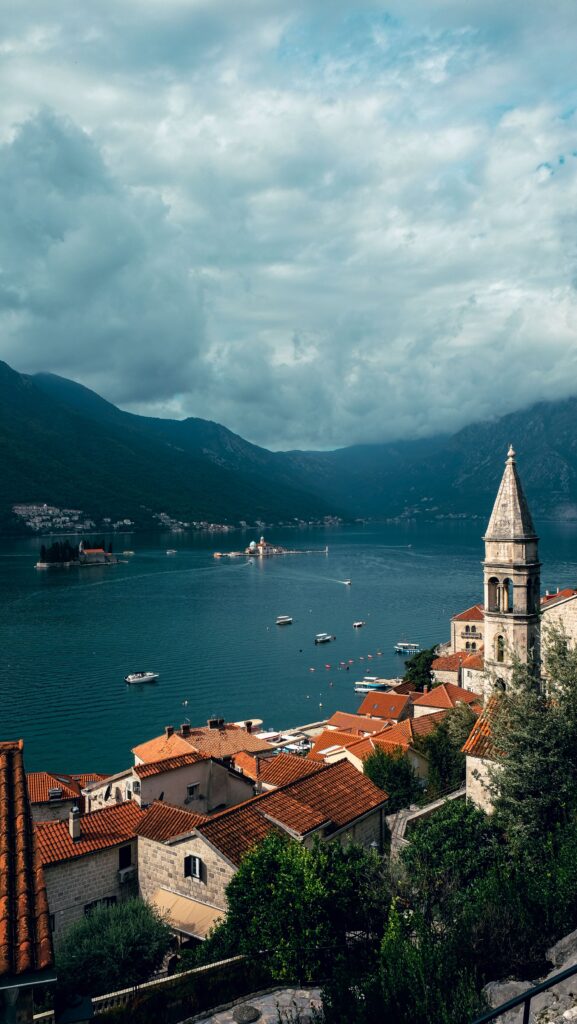
Bay of Kotor Boat Tour
A half-day boat tour on the bay is the other recommended thing to do in Kotor. The bay’s S-curves and the fjord-like scale are only visible from the water. Tours typically include Our Lady of the Rocks, a stop for swimming, and some include the Blue Cave near the bay entrance.
Multiple operators depart from Kotor marina. Most tours are €30-60 per person for 3 hours. Full-day versions add more stops and run €50-80. Book directly at the marina or through GetYourGuide for advance booking.
Costs in 2026
Montenegro uses euros. No currency exchange needed.
| Item | Price |
|---|---|
| Fortress walls entry | €15 (free before 8AM and after 8PM) |
| Cathedral of Saint Tryphon | €4 |
| Maritime Museum | €5 |
| Cat Museum | €1 |
| Our Lady of the Rocks boat crossing | ~€5 |
| Half-day bay boat tour | €30-60 |
| Espresso | €1.20-1.80 |
| Beer | €2-4 |
| Local restaurant dinner | €10-25 |
| Kotor-Budva bus | €3.50 |
| Dubrovnik-Kotor taxi | €70-90 |
| Budget daily total | €50-80 |
| Mid-range daily total | €100-150 |
Getting to Kotor
From Dubrovnik: 2 hours by car or taxi (€70-90). The most common route. A long day trip covers the old town, the fortress, and Perast with a boat ride. Bus options also exist at lower cost (~€10-15 one-way) with longer journey times.
By air: Tivat Airport (TIV) is 20 minutes from Kotor — the closest option. Podgorica Airport (TGD) is 1.5 hours. Most European travelers use Dubrovnik Airport (Croatia), 1 hour away, which has better route coverage.
Within Montenegro: Kotor to Budva by local bus: €3.50, 30 minutes. Montenegro is compact — the entire country is driveable in a day.
When to Visit Kotor
May and June: The best months. Warm (20-25°C), fewer cruise ships, Perast at its most accessible, the bay road free from traffic.
July-August: Full tourist season. Cruise ships most frequent. Fortress and old town crowded from 10AM. Hot (28-35°C). Fašinada on July 22. Go early, stay late.
September-October: Sea still warm, significantly fewer tourists, better prices. September is arguably the optimal Kotor month for most visitors.
Winter: Cold but the old town has a completely different atmosphere. Very few tourists. Some restaurants and accommodation close. The fortifications are less maintained in winter and the fortress approach can be wet.
FAQ
How much does backpacking Eastern Europe cost per day in 2026?
Albania, Bosnia, Bulgaria, and Serbia cost around €25-45 per day on a backpacker budget, assuming hostel dorms, local restaurants, and public transport. Budapest is closer to €55-70 per day, while Prague is usually around €60-85 per day. The Balkans are still the cheap part of Eastern Europe; Central Eastern Europe is less so. Belgrade is the specific outlier because public transport has been free since January 1, 2025.
What is the cheapest Eastern European country to backpack?
Albania and Bosnia are the strongest cheap backpacking picks, with around €30-40 per day achievable outside peak coastal season. Serbia follows closely, and Belgrade’s free public transport makes it effectively cheaper than the daily rate suggests. Bulgaria is comparable for city travel, especially Sofia and Plovdiv, though prices vary by season and route.
Is Eastern Europe still cheap in 2026?
The Balkans are still genuinely cheap in 2026, especially Albania, Bosnia, Serbia, and Bulgaria. Budapest and Prague have risen steadily and are no longer cheap by Eastern European standards, though they remain below many Western European capitals. The Post Office City Costs Barometer 2026 ranked Sarajevo as Europe’s best-value city break, with Belgrade also in the top-value group.
How long does it take to backpack Eastern Europe?
Two weeks is the minimum for a meaningful Balkans or Eastern Europe backpacking circuit. A 14-night route such as Budapest, Belgrade, Sarajevo, Plovdiv, Sofia, and Brașov covers six cities without becoming too rushed. Three weeks is better if you want to add Albania, slower travel days, or extra stops like Novi Sad, Mostar, Ohrid, or the Albanian coast.
What is the best Eastern Europe backpacker route in 2026?
The classic Balkans route is Budapest to Belgrade, then Sarajevo, Sofia, and Plovdiv, using trains and buses where practical. For current long-distance buses, check FlixBus, and for Serbian trains use Srbija Voz. The newer 2026 budget route starts in Tirana, helped by Ryanair’s expanded Tirana base: Tirana, Ohrid or Skopje, Belgrade, and Sarajevo.
Related articles:
- Eastern Europe Travel Guide 2026
- Day Trips from Sarajevo 2026
- Albania Travel Guide 2026
- Eastern Europe Summer Travel Deals 2026
Created by WanderGuide Travel Desk
Practical travel planning, built for independent travellers.
WanderGuide articles are created using official tourism and transport sources, route research, hotel-area checks, cost comparisons, local travel context and practical itinerary planning for first-time and budget-conscious travellers.
Read our editorial approach