
Two weeks ago, the UK Post Office published its 2026 City Costs Barometer across 50 European cities. Sarajevo ranked #1 for value at £248 for a 48-hour break, while Belgrade ranked #4 at £265.
At first glance, that makes Sarajevo look like the clear budget winner. But the Barometer was measured before Belgrade’s public transport became entirely free in January 2025. City buses, trams, trolleybuses, and the suburban train network now cost nothing in Belgrade. Sarajevo’s tram, by comparison, costs 2.20 KM, or around 90p, per journey.
Over three days of regular city travel, that difference adds up. So the real Sarajevo vs Belgrade cost gap is narrower than it looks on paper. The better choice depends less on the headline price and more on the kind of trip you want to build.
Sarajevo is better for Ottoman history, compact old-town wandering, mountain views, and a slower cultural trip. Belgrade is better for nightlife, riverfront energy, museums, cafés, and a bigger-city Balkan break.
Post Office City Costs Barometer 2026: Sarajevo £248, Belgrade £265. Source: postoffice.co.uk/citycosts, published May 25, 2026.
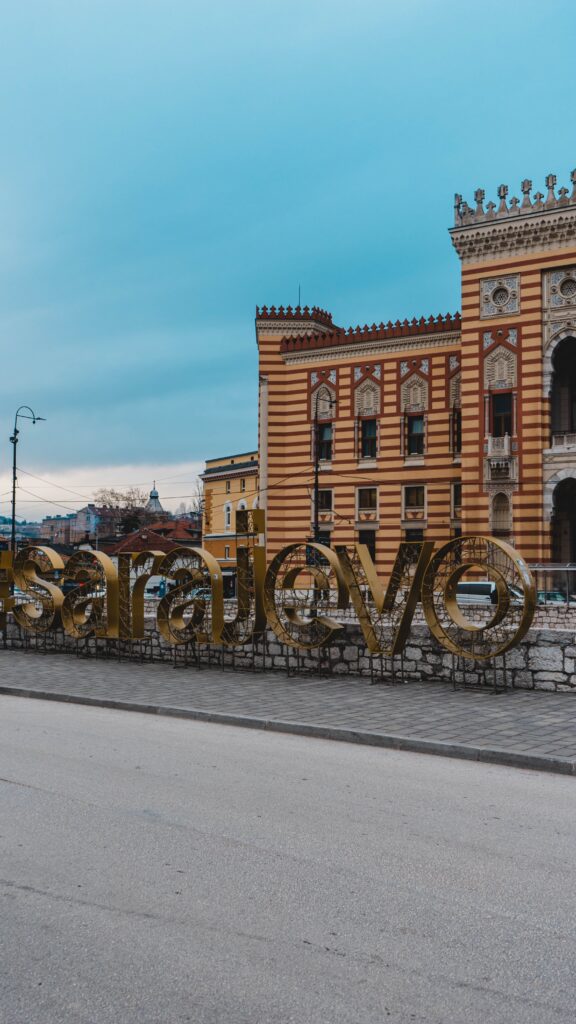
Sarajevo vs Belgrade Cost: Who Wins in 2026?
On paper: Sarajevo. £248 vs £265 for equivalent 48-hour breaks across accommodation, meals, drinks, transport, and cultural attractions.
Corrected for free transport: Belgrade closes the gap significantly. The Barometer measured transport costs before Belgrade’s January 2025 change. Belgrade’s daily transport is now €0 for standard city journeys. Sarajevo still charges per-journey. For a budget traveler doing three nights with regular tram and bus use, the real gap between the two cities is smaller than the headline Barometer figures suggest.
Food costs: Both cities sit in the same range. A meal at an inexpensive Sarajevo restaurant runs ~15 KM (~£6.74). A ćevapi plate in Belgrade runs ~600-900 RSD (~€5.50-8). A coffee: Sarajevo ~3.61 KM (~£1.62), Belgrade ~261 RSD (~€2.40).
Accommodation: Slightly cheaper in Sarajevo at the budget guesthouse tier. A well-reviewed old-town guesthouse with breakfast included (Halvat, 9.8 Booking.com) runs ~€30-40 per night. Equivalent Belgrade central budget hotels run €35-65. The Bosnian breakfast inclusion — which often replaces €5-8 in café spend — reduces the gap further.
Verdict on cost: Both cities are exceptional value. If raw daily spend is the deciding factor, Sarajevo edges it slightly. If you factor in Belgrade’s free transport, the gap is marginal and other considerations should drive the decision.
History and Culture: Who Wins?
Sarajevo — by a clear margin for historical depth.
Sarajevo has more historically specific, emotionally affecting material concentrated in a smaller area than almost any European city. Latin Bridge (Franz Ferdinand assassination, 1914, triggering WWI). The Tunnel of Hope (the only supply route into besieged Sarajevo during the 1992-1995 siege). The War Childhood Museum. Baščaršija — an Ottoman old bazaar still functioning as it has for centuries. The Yellow Fortress. The architectural layer-cake of Ottoman, Austro-Hungarian, Yugoslav, and modern rebuilding.
Belgrade has strong historical material too — Kalemegdan Fortress, the Nikola Tesla Museum, the Sava-Danube confluence, the communist-era heavy industry and socialist housing belts. But Belgrade’s history is dispersed rather than concentrated. You can spend three days in Sarajevo’s old town and keep finding things. Belgrade’s best historical content requires more navigation.
Verdict on culture and history: Sarajevo. Not close.
Atmosphere and Vibe: Who Wins?
They’re not competing. This is the most important thing the comparison guides get wrong. Sarajevo and Belgrade feel nothing like each other.
Sarajevo is compact, walkable, Ottoman-inflected. Coffee culture is specific and slow — Bosnian coffee in a copper džezva, sugar cube, sitting for two hours is standard. The old town closes in on itself in a way that feels intimate. The war history is present whether you seek it or not. The city has a spiritual quality — multiple religious buildings within metres of each other, calls to prayer, the weight of recent history in the streets.
Belgrade is a bigger, louder, faster city. The nightlife is one of Europe’s best by any objective metric — splavovi (floating river clubs), Savamala bars, a scene that runs until morning and takes itself seriously. The café culture exists but it doesn’t define the city the way it does in Sarajevo. Belgrade’s energy is outward and social; Sarajevo’s is inward and layered.
Verdict on vibe: Depends entirely on what you want. If you want big-city energy and nightlife: Belgrade. If you want atmosphere, layered history, and intimacy: Sarajevo.
Sarajevo vs Belgrade Nightlife: Who Wins?
Belgrade — no contest.
Belgrade’s splavovi (floating river clubs on the Sava and Danube), Savamala bar district, and underground club scene constitute one of the best nightlife ecosystems in Europe. Multiple major international outlets have named Belgrade in Europe’s top five nightlife cities. The scene starts late, runs until morning, and offers electronic music, turbo-folk, jazz, and live music simultaneously across different venues.
Sarajevo has bars and a decent evening scene, particularly in the Ferhadija/ centre area and some kafanas in Baščaršija. It works for a pleasant evening. It does not work for a dedicated nightlife trip.
Verdict on nightlife: Belgrade by a significant margin.
Sarajevo vs Belgrade Food: Who Wins?
A genuine tie — different categories.
Sarajevo wins on specificity. Bosnian food is distinct from Serbian food in ways that matter: ćevapi in Sarajevo (smaller, served in somun flatbread with kajmak and raw onion, at Ćevabdžinica Željo — TasteAtlas #1 with 8,100+ ratings) is different from ćevapi in Belgrade. Burek, begova čorba (Bey’s soup), a proper Bosnian breakfast spread — these are things that exist fully in Sarajevo and incompletely elsewhere. Sarajevo also wins on guesthouse breakfast inclusion as a budget multiplier.
Belgrade wins on variety and scale. More restaurants, more cuisines, more price points, better mid-range restaurant options. The kafana tradition in Skadarlija is one of Europe’s more distinctive dining experiences (dinner with live tamburica music, rakija, grilled meat, ~€25-44 per person with drinks).
Verdict on food: Sarajevo for cultural specificity and value. Belgrade for variety and the kafana experience.
Practical Comparison
| Category | Sarajevo | Belgrade |
|---|---|---|
| 48-hour cost (Post Office 2026) | £248 (~€287) | £265 (~€307) |
| City transport | ~2.20 KM/journey (~90p) | FREE since Jan 2025 |
| Budget daily | ~€33-37 | ~€23-38 |
| Old town / historic centre | Ottoman, concentrated, walkable | Spread out, mixed eras |
| Nightlife | Moderate | One of Europe’s best |
| History depth | Exceptional (WWI, siege, Ottoman) | Good (fortress, Tesla, communist) |
| Best hostel/guesthouse | Halvat (9.8 BK, old town) | Balkan Soul (8.9 HW, 1,708 reviews) |
| Summer festival | 32nd SFF: Aug 14-21, 2026 | EXIT (Novi Sad): Jul 10-13, 2026 |
| Safe for solo travelers | Yes — consistently rated comfortable | Yes — Level 1 US State Dept |
| Getting there | Smaller airport, fewer routes | Larger airport, Wizz Air hub |
| FlixBus between cities | ~6-7 hours, ~€15-25 | ~6-7 hours, ~€15-25 |
Can You Visit Both? The 5-7 Day Route
Yes. FlixBus runs Sarajevo-Belgrade in approximately 6-7 hours, priced ~€15-25 depending on season and how far ahead you book. Night buses also operate. The practical route:
5-day option:
- Belgrade: 2 nights (Kalemegdan, Skadarlija, Tesla Museum, Savamala)
- FlixBus to Sarajevo: overnight or early morning (~6-7 hrs)
- Sarajevo: 3 nights (Baščaršija, Yellow Fortress, Tunnel of Hope, Mostar day trip)
7-day option:
- Belgrade: 3 nights (add Novi Sad day trip via SOKO train, Šargan Eight)
- FlixBus to Sarajevo: daytime departure
- Sarajevo: 4 nights (adds Mostar overnight for those who want it)
The direction matters. Belgrade → Sarajevo works well because you arrive rested in Sarajevo and have time to settle into the old town. Sarajevo → Belgrade also works if you want to end on Belgrade’s nightlife.
Summer planning: If you’re doing both in summer, note that EXIT Festival (Novi Sad/Belgrade area, July 10-13) and the Sarajevo Film Festival (August 14-21) fall in different windows. A June or September trip avoids festival accommodation pressure in both cities while remaining warm enough for both.
Belgrade full itinerary: 3 Days in Belgrade 2026 Sarajevo full guide: Is Sarajevo Worth Visiting in 2026?
Who Should Visit Which
Choose Sarajevo if:
- History, Ottoman culture, and war history are primary interests
- You want a compact, atmospheric old town you can understand in 2-3 days
- Budget hospitality (guesthouses with breakfast) is the priority
- You want Europe’s #1 value city break in 2026 (Post Office Barometer)
Choose Belgrade if:
- Nightlife and a big-city energy are what you’re after
- You want variety — food, nightlife, day trips to Novi Sad and Golubac
- Free citywide transport appeals
- You want more options for onward connections (larger airport, Wizz Air)
Do both if:
- You have 5-7 days in the region
- A Balkans loop is the goal (Belgrade → Sarajevo → Mostar → Split or reverse)
- You can handle a 6-7 hour bus day between two nights in each city
FAQ
Is Sarajevo better than Belgrade?
It depends on the traveller. Sarajevo is better for history, culture, Ottoman atmosphere, and compact walkable intensity. Belgrade is better for nightlife, city scale, variety, and a bigger urban experience. The Post Office City Costs Barometer 2026 ranks Sarajevo as Europe’s best-value city break, while Belgrade also sits among the cheapest major city breaks in Europe. If you have 5+ days, doing both is the strongest option.
Is Sarajevo cheaper than Belgrade?
Marginally. The Post Office City Costs Barometer 2026 puts Sarajevo at £248 for a 48-hour city break, with Belgrade also ranked in Europe’s top-value group. However, Belgrade public transport has been free since January 1, 2025, covering city and suburban buses, trams, trolleybuses, and the BG Train. That makes the real cost gap narrower than the headline city-break figures suggest.
Can you visit both Sarajevo and Belgrade in one trip?
Yes. FlixBus runs between Sarajevo and Belgrade, with night buses also available on some schedules. A practical 5-day route is 2 nights in Belgrade, bus to Sarajevo, then 3 nights in Sarajevo. A 7-day version adds a Novi Sad day trip from Belgrade and a Mostar day trip from Sarajevo.
Which is better for nightlife: Sarajevo or Belgrade?
Belgrade, clearly. The city is known for splavovi floating river clubs on the Sava and Danube, the Savamala bar district, and an underground club scene. Start with the Tourist Organization of Belgrade nightlife guide for official nightlife context. Sarajevo has bars and a strong café culture, but it does not compete with Belgrade specifically for nightlife.
Which is better for history: Sarajevo or Belgrade?
Sarajevo is better for concentrated, emotionally powerful history. The Latin Bridge area, the Tunnel of Hope, the War Childhood Museum, and Baščaršija give Sarajevo more historically specific material per square kilometre than almost any European city. Belgrade has Kalemegdan Fortress and the Nikola Tesla Museum, but its major sights are more dispersed.
Related articles:
- Is Sarajevo Worth Visiting in 2026?
- 3 Days in Belgrade 2026
- Where to Stay in Sarajevo 2026
- Where to Stay in Belgrade 2026
- Eastern Europe Travel Guide 2026
Created by WanderGuide Travel Desk
Practical travel planning, built for independent travellers.
WanderGuide articles are created using official tourism and transport sources, route research, hotel-area checks, cost comparisons, local travel context and practical itinerary planning for first-time and budget-conscious travellers.
Read our editorial approach