
Tirana is the cheapest capital in Europe to visit, making it one of the strongest choices for a Tirana Travel Guide 2026 focused on budget travel. Budget travelers average 4,325–5,767 ALL (~€39–52) per day. The airport bus to the city centre costs 400 ALL (~€3.50). Bunk’Art 2 entry is ~500 ALL (~€4.50). The Pyramid is free and climbable 24 hours.
Tirana was the European Capital of Culture in 2025 — the first Balkan city to hold the title — which accelerated a cultural transformation already underway. The Pyramid reopened as a youth technology centre in 2023. Enver Hoxha’s former private villa in Blloku opened as an active art residency and public cultural space in January 2025 and welcomed 30,000 visitors in its first year.
Two full days covers the essentials. Three days includes a day trip and slower mornings.
All prices in Albanian Lek (ALL). Exchange rate: ~83 ALL = $1 USD; ~110 ALL = €1.
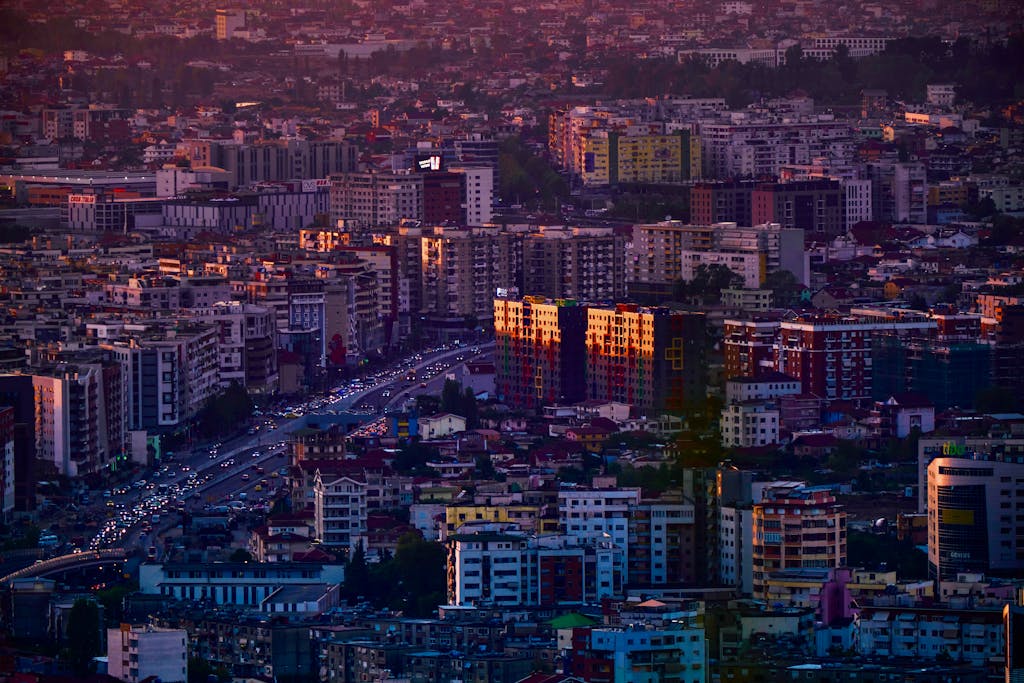
Is Tirana Worth Visiting?
Yes — for a specific traveler.
Tirana rewards people who find communist history viscerally interesting, who like cities that are transforming rather than polished, and who want a Balkan capital that isn’t yet shaped primarily by tourism. The Pyramid, Bunk’Art, Vila 31, the House of Leaves, and the Blloku story together constitute one of the most concentrated collections of post-communist historical material in Europe. All of it is walkable from a central hotel.
Tirana is not right for travelers who want a preserved old town, conventional European architecture, or seamless tourist infrastructure. It is messy, unfinished in places, and chaotic in traffic. That’s part of what makes it interesting. If the gap between the communism-shaped city and the café-dense, nightlife-heavy city it’s becoming is something you find compelling, Tirana usually delivers.
Getting From the Airport
Mother Teresa International Airport (TIA) is 17km from central Tirana.
Airport bus (Line 2): Departs hourly from outside arrivals. Cost: 400 ALL (~€3.50). Journey time approximately 25 minutes to the city centre. Most reliable option if you arrive during daylight with manageable luggage.
Official airport taxi: ~2,000-2,500 ALL (~€18-23) to the city centre. Yellow taxis are the legitimate ones — agree the price before getting in. Do not accept a ride from anyone who approaches you before you’ve reached the official taxi rank. Faster than the bus, essential for late arrivals.
Bolt: Works at the airport for fixed app-priced rides. A reliable alternative to negotiated taxi fares.
Tirana Travel Guide: What to Do in Europe’s Cheapest Capital in 2026
The Pyramid of Tirana
The most important development in the city’s recent history is fully open and free.
Built in 1988 as a museum to glorify Enver Hoxha — the regime that isolated Albania from the world, banned religion, and constructed approximately 170,000 concrete bunkers across the country — the Pyramid sat decaying for decades after the regime collapsed. Dutch architects MVRDV completed its transformation in October 2023. The original concrete shell is intact. Steps were added to the sloping facades so visitors can climb to the top — 24 hours a day, at no cost. The original marble cladding was ground up and used as aggregate for those steps. Visitors walk on the physical material of Hoxha’s monument.
Inside: TUMO Tirana, a non-profit providing free technology education in software, robotics, animation, music, and film to Albanian youth aged 12-18.
Address: Bulevardi Dëshmorët e Kombit, ~10 min walk from Skanderbeg Square Cost: Free, 24 hours Suggested time: 30-45 minutes
Vila 31: Hoxha’s Former Home
In the heart of Blloku, at what was once the most restricted address in Albania, stands Vila 31.
This is the house where Enver Hoxha actually lived. Built in 1942 by an Italian architect and occupied by Hoxha shortly after he took power, it sat in a district entirely sealed off from ordinary Albanians — guarded by armed security, accessible only to the Politburo. In January 2025, renovated by NeM Architects and partnered with French foundation Art Explora, it opened as an active art residency and public cultural centre.
The numbers from its inaugural 2025 year: 29 artists from 15 nationalities in residence, more than 100 public events — exhibitions, workshops, film screenings, performances — and 30,000 visitors. Not a museum. Not a memorial. An active, living cultural space inside the physical building where the dictatorship was organised.
The contrast with what the building was — inaccessible, secret, the nerve centre of state control — and what it is now is the reason to visit. The marble floors, the pastel-painted walls, the scale of a private residence that was the epicentre of a paranoid state.
Location: Blloku, inside the former restricted zone
Open: Check artexplora.org or the Visit Tirana site for current programme and opening hours — events vary weekly
Cost: Free or low-cost for public events; check current programme
Bunk’Art 2
In the city centre. Focuses specifically on the Sigurimi — Albania’s communist-era secret police — and the Ministry of Interior. Documents how surveillance and political repression functioned at a human scale: photographs, personal accounts, intercepted letters, equipment.
Cost: ~500 ALL (~€4.50) adults. Buy at entrance; online ticketing available. Best for: first-time visitor who wants one focused museum visit Suggested time: 1-1.5 hours
Bunk’Art 1
The actual nuclear bunker built for Albania’s communist leadership. Large underground complex designed to shelter the Politburo through a nuclear war. The scale changes the experience from Bunk’Art 2 — this is about the physical infrastructure of paranoia rather than its human consequences.
Getting there: city bus (blue bus toward Porcelan from near Skanderbeg Square, ~30 ALL fare; get off at Dajti Ekspres stop and follow signs).
Cost: ~700-800 ALL (~€6-7) adults; audio guide extra ~200 ALL Best for: travelers who want immersive communist history after Bunk’Art 2 Suggested time: 2 hours including travel
Visit both if communist history is the primary reason you’re here. Visit Bunk’Art 2 first if you only have time for one — it’s central, tighter, and the narrative is sharper.
The House of Leaves (Shtëpia e Gjetheve)
A former surveillance villa that operated as an interception and monitoring centre during the communist period. Smaller and more intimate than Bunk’Art — the rooms are household-scale, the equipment ordinary-looking. The scale of what it enabled is the unsettling part.
IndieT, currently the strongest editorial Tirana guide on the SERP, rates it as comparable to Bunk’Art 2 in emotional impact. For travelers who want the surveillance story in a more personal frame than the Sigurimi’s institutional history, House of Leaves delivers it.
Address: Rruga Egrem Çabej 4, central Tirana Suggested time: 1 hour
Skanderbeg Square and Et’hem Bey Mosque
Start here on day one for orientation. The square is large and somewhat cold architecturally, but the National History Museum exterior mosaic (socialist realist, enormous, worth seeing even if you don’t go inside), Et’hem Bey Mosque (18th century, painted interior more delicate than the exterior suggests, open to all — shoes off), and the Clock Tower cluster give you the city’s core landmarks in 45-60 minutes.
Cost: Free (mosque has a small donation box)
Blloku District
Until 1991, Blloku was inaccessible to ordinary Albanians. The entire district was reserved for the Politburo and senior Communist Party members — guarded perimeter, no entry for regular citizens. Today: the highest density of cafés, bars, cocktail spots, and restaurants in Albania.
Come in the afternoon for coffee. Albanian café culture is serious — an espresso costs ~100-200 ALL (~€0.90-1.80) and sitting for two hours is expected. Return for dinner or drinks in the evening. The bar scene runs late and doesn’t follow Western European closing conventions.
Vila 31 is inside Blloku — combine both on the same afternoon.
Dajti Ekspres Cable Car
Runs from the eastern edge of the city up to Mount Dajti. Views over Tirana and toward the coast on clear days. Hiking trails and a restaurant at the top. Closed Tuesdays.
Return ticket: ~1,500 ALL (~€13.50) Suggested time: half day
National Gallery of Fine Arts
Was closed for extensive renovation “until 2026.” Verify current status at Visit Tirana before including in your plans. If it has reopened, it holds Albanian and international art spanning from the national renaissance through the communist period — the socialist realist collection alone is worth seeing.
The New Bazaar (Pazari i Ri)
The New Bazaar, rebuilt around Avni Rustemi Square, is where Tirana feels most like itself on a normal day — fruit stalls, butchers, cafés, locals rather than tourists. The architecture of the rebuilt bazaar is a bit too clean, but the activity around it is genuine.
Good for a late morning wander before lunch. The surrounding streets have some of the better cheap restaurants in the city.
Suggested time: 1-2 hours
Tirana Costs in 2026
| Item | ALL | EUR approx |
|---|---|---|
| Airport bus | 400 ALL | ~€3.50 |
| Airport taxi | ~2,000-2,500 ALL | ~€18-23 |
| City bus fare | ~30-50 ALL | ~€0.25-0.45 |
| Coffee | ~100-200 ALL | ~€0.90-1.80 |
| Byrek (street pastry) | ~200 ALL | ~€1.80 |
| Bunk’Art 2 entry | ~500 ALL | ~€4.50 |
| Bunk’Art 1 entry | ~700-800 ALL | ~€6-7 |
| Dajti Ekspres return | ~1,500 ALL | ~€13.50 |
| Pyramid | Free | Free |
| Vila 31 events | Free or low cost | Free-€5 |
| Tavë kosi (national dish) | ~720-1,328 ALL | ~€6.50-12 |
| Raki (shot) | ~144-288 ALL | ~€1.30-2.60 |
| Local beer | ~200-300 ALL | ~€1.80-2.70 |
| Budget daily total | 4,325-5,767 ALL | ~€39-52 |
| Mid-range daily total | 11,053-12,975 ALL | ~€100-118 |
2-Day Tirana Itinerary
Day 1
Morning: Skanderbeg Square, Et’hem Bey Mosque, National History Museum exterior. Walk 10 minutes south along Bulevardi Dëshmorët e Kombit to the Pyramid. Climb it. 30-40 minutes.
Continue to Bunk’Art 2. Allow 1-1.5 hours.
Lunch: Blloku or New Bazaar area. Byrek from a street stall ~200 ALL. Sit-down lunch with tavë kosi: ~800-1,500 ALL.
Afternoon: Vila 31 in Blloku. Check the programme at artexplora.org for what’s running during your visit — there’s usually an exhibition or open event. If nothing appeals, the building itself and its courtyard are worth 30 minutes.
Stay in Blloku for coffee and evening drinks. The bar scene starts around 9pm.
Day 2
Morning: Bunk’Art 1 (allow 2 hours including travel) or House of Leaves (1 hour, central).
Afternoon: Dajti Ekspres cable car for the mountain views, or the Artificial Lake of Tirana for a flat, café-lined walk.
Evening: Grand Park of Tirana for a final walk, then dinner in Blloku.
Best Time to Visit
April, May, June, September, and October give the best balance of weather and walkability. July and August are hot (regularly 30°C+) but the city functions — the cultural programme doesn’t stop for summer.
Tirana works year-round in a way the Albanian Riviera doesn’t. Winter is cold but the café culture, the museums, and the Blloku scene all operate. Prices drop noticeably in November through February.
FAQ
Is Tirana worth visiting in 2026?
Yes. Tirana is worth visiting in 2026 if you are interested in communist history, post-communist transformation, or Albanian culture. The Pyramid of Tirana, Bunk’Art, Vila 31, and the House of Leaves make it one of Europe’s most concentrated cities for post-communist historical material. It is not the right choice if you want a polished old town or conventional European beauty — Tirana is still messy and unfinished in places.
How many days do you need in Tirana?
Two full days is the right amount of time for Tirana. That lets you visit the Pyramid, both Bunk’Art museums, Vila 31, the House of Leaves, and Blloku without rushing. Three days allows a day trip to Krujë and slower mornings. One day is only a transit stop: you will see Skanderbeg Square and one museum, but only get a surface reading of the city.
What is Tirana known for?
Tirana is known for the Pyramid, a former Hoxha-era monument now used as a public technology and cultural space; Bunk’Art, Albania’s communist-era bunker museums; Blloku, once closed to ordinary Albanians and now the city’s nightlife centre; Vila 31, Enver Hoxha’s former private residence; and the House of Leaves, the museum of secret surveillance.
Is Tirana cheap to visit?
Yes. Tirana is one of the cheaper capitals in Europe. Budget travellers can often manage on around 4,325-5,767 ALL per day, while a mid-range daily spend is closer to 11,053-12,975 ALL. The airport bus costs around 400 ALL, Bunk’Art 2 entry is usually low-cost by European museum standards, and the Pyramid of Tirana is free to walk around and climb.
How do you get from Tirana airport to the city centre?
The airport bus is the cheapest option from Tirana International Airport to the city centre. The airport is around 17 km from Skanderbeg Square, and buses, official taxis, and ride-hailing apps are the main choices. Check the official Tirana Airport bus information before arrival, and use the official taxi rank if you prefer a taxi.
Is Vila 31 open to visitors?
Yes. Vila 31, Enver Hoxha’s former private residence in Blloku, opened as an art residency and public cultural space. It hosts exhibitions, workshops, screenings, and performances, but the programme changes week to week. Check Art Explora’s Vila 31 page or Visit Tirana for current events and opening details before going.
Related articles:
- Albania Travel Guide 2026
- Eastern Europe Travel Guide 2026
- Best Cheap Hostels in Eastern Europe 2026
- Eastern Europe Summer Travel Deals 2026
- Albania Coast: Ksamil vs Sarandë vs Vlorë
Created by WanderGuide Travel Desk
Practical travel planning, built for independent travellers.
WanderGuide articles are created using official tourism and transport sources, route research, hotel-area checks, cost comparisons, local travel context and practical itinerary planning for first-time and budget-conscious travellers.
Read our editorial approach