
Bucharest is not a polished city. Elegant Belle Époque mansions sit beside grey communist apartment blocks. The Old Town has medieval ruins and hipster cocktail bars on the same street. The Palace of Parliament — the world’s heaviest building, built by Ceaușescu and never formally finished — looms over the southwest of the city like an architectural fever dream.
It’s real in a way that many Eastern European capitals, now thoroughly tourist-processed, have stopped being. That’s either the reason to go or the reason to go elsewhere, depending on what you want from a city break.
Before the guide: three things to know before you arrive.
Currency: Romanian Leu (RON). ~5 RON = €1; ~4.6 RON = $1. Romania uses RON, not euros.
Bucharest Travel Guide: Three Things to Know Before You Arrive
1. Street taxis outside Gara de Nord and the Old Town may refuse to use the meter or apply a “tourist rate.” Don’t negotiate. Use Uber or Bolt instead — both work in Bucharest, both give upfront fixed prices. A 5km city trip runs about 30 RON (~€6) by app. Save the Uber/Bolt app before arriving.
2. Euronet ATMs — the blue and yellow ones in high-traffic tourist areas — charge high transaction fees and use poor exchange rates. Use bank-affiliated ATMs: BCR or BRD branches are throughout the city. This is the same Euronet warning as Belgrade; the principle is identical.
3. Some bars in Centru Vechi (Old Town) provide menus without prices, leading to an unexpectedly high bill. Ask for a priced menu before ordering. If none is provided: ask specifically what each drink costs before ordering. Walk to the next bar if the response is evasive.
Is Bucharest Worth Visiting?
Yes — with the right expectations.
romanianfriend.com, the most thorough local guide for Bucharest, opens with: “Before we begin, let’s be honest. Bucharest doesn’t have the best reputation as a tourist destination.” That honesty is also the guide: Bucharest is an acquired taste that rewards visitors who arrive curious rather than expecting a postcard.
The nightlife is genuinely one of Europe’s best — hipster cafés, bars open until dawn, fine dining at prices that seem wrong compared to Western Europe. The architecture is fascinating precisely because none of it matches. The food is underrated. The Palace of Parliament is one of the most extraordinary buildings in Europe, for completely wrong reasons.
Romania is now in the Schengen Area (full integration including land borders completed early 2025). Days in Bucharest count toward your 90-day Schengen limit.
Getting to and Around Bucharest
Airport to City Centre
Train (recommended): Henri Coandă International Airport to Gara de Nord (main railway station): 5.5 RON (~€1.10). Approximately 30 minutes. This is one of the cheapest airport rail connections in Europe. The train departs from below Terminal 1.
Uber/Bolt: ~70-100 RON (~€14-20) from the airport. Faster if you have luggage and want door-to-door. Both apps work in Bucharest.
Official taxi: Metered price should be ~80-100 RON. The airport has official taxi ranks — use these if not using an app. Do not accept offers from drivers who approach you before the rank.
Getting Around the City
Metro: Clean, reliable, well-connected. Single ticket: ~3 RON. 24-hour pass: 16 RON (~€3.20). The 24-hour tourist card (covers metro + trams + the airport train) costs 20 RON (~€4) and is worth it for a full day of sightseeing.
Bus/tram: 90-minute ticket: 3.01 RON (~€0.60). Good for routes the metro doesn’t reach.
Uber/Bolt: Both work throughout the city. ~30 RON (~€6) for a typical 5km trip. Use instead of street taxis when going to/from Gara de Nord or the Old Town.
What to Do in Bucharest
The Calea Victoriei Walk
The single best way to understand Bucharest in one afternoon: walk south down Calea Victoriei (Victory Avenue) from the Romanian Athenaeum.
Romanian Athenaeum: Neo-Classical concert hall at the north end of Calea Victoriei. The exterior is free — worth seeing as a starting point.
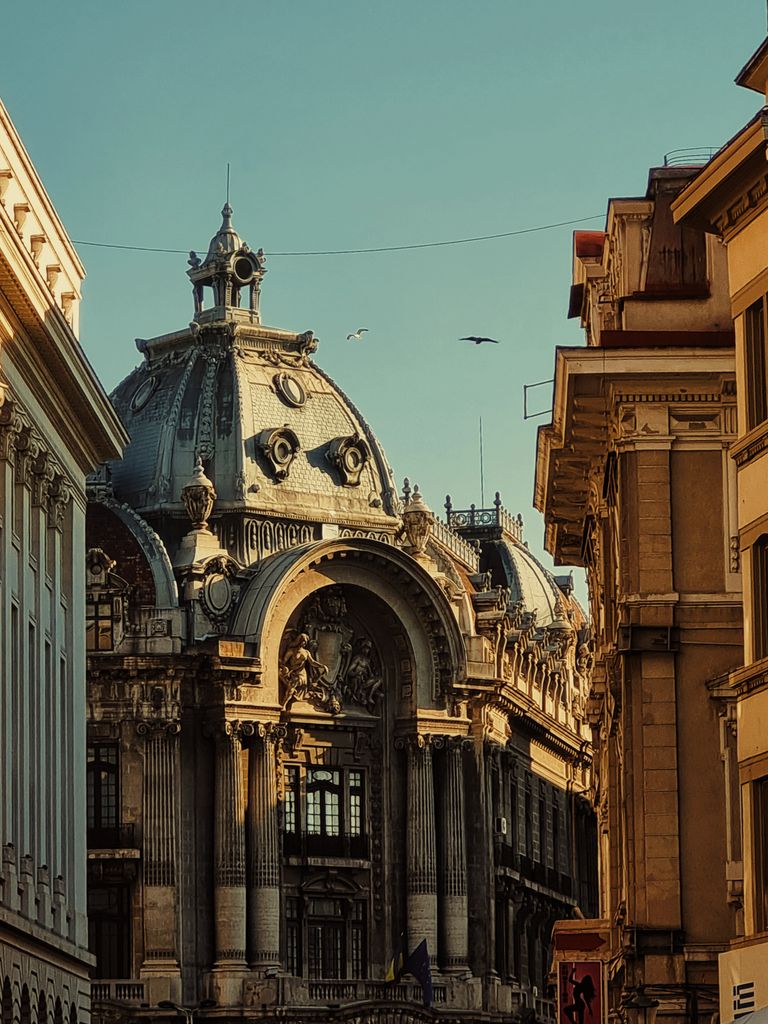
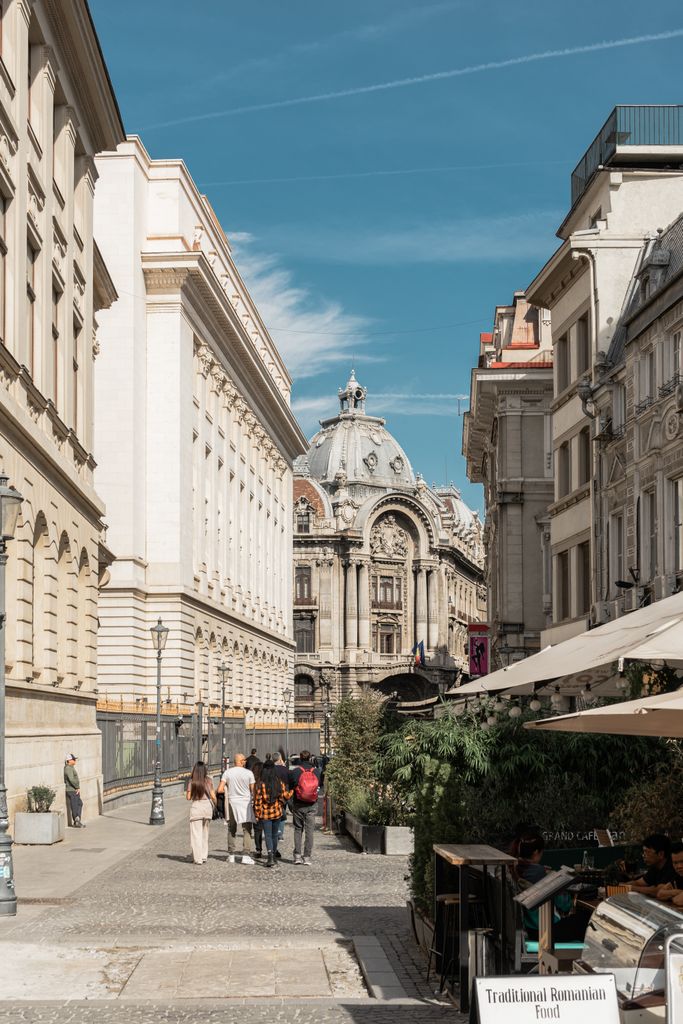
South along Calea Victoriei: Belle Époque mansions, some still intact, some crumbling, some converted to offices. The CEC Palace (1897, ornate, the main savings bank) and the National History Museum are mid-route. The architecture is the walk — don’t rush.
Revolution Square: The balcony from which Ceaușescu gave his final speech in December 1989, two days before he was executed. The bullet holes in surrounding buildings were intentionally left as memorials. This is one of the most historically specific public squares in Europe, and most visitors walk through it without realising.
Lipscani (Old Town): At the southern end of Calea Victoriei — the medieval quarter with bars, restaurants, and the ruins of the 15th-century Curtea Veche (Old Princely Court) visible through a fence. Have a beer in Caru’ cu Bere (see below) and walk the lanes.
Strada Arthur Verona: Street art and murals. A 5-minute detour into Bucharest’s creative side.
The full walk takes 1.5-2 hours at a slow pace. It’s the Bucharest version of a city orientation that no tour can replicate.
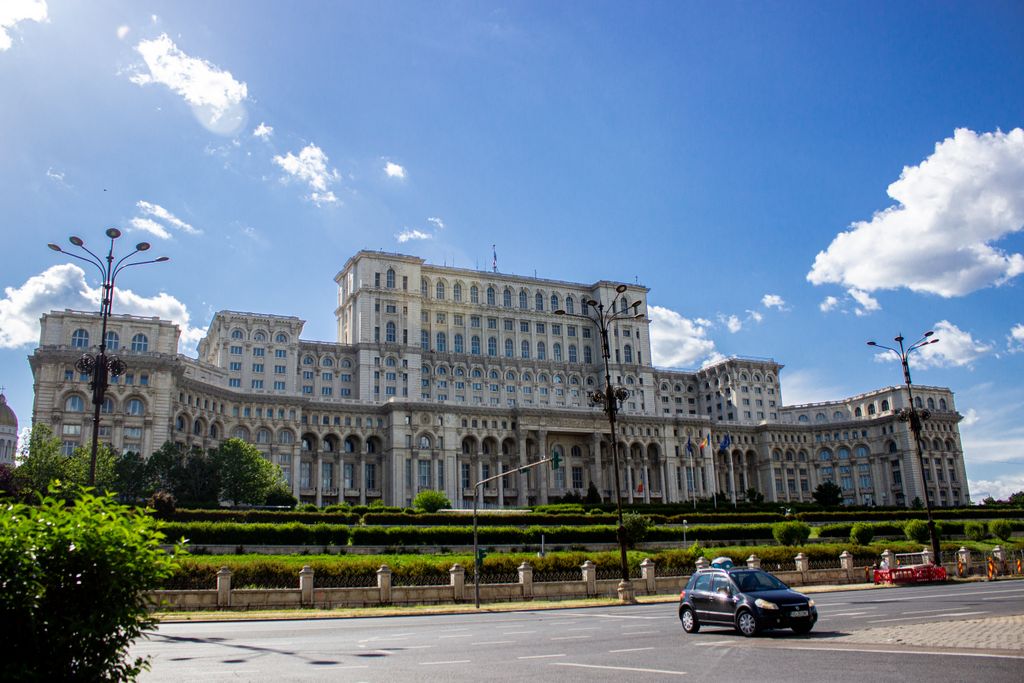
Palace of Parliament (Casa Poporului)
The world’s heaviest building. The second-largest government building on Earth after the Pentagon. 3,000+ rooms. Started in 1984 under Ceaușescu as a monument to communist power; construction continued after his 1989 execution and it was never formally completed. The building was so massive that entire Bucharest neighbourhoods were demolished to make room for it.
Inside: marble, chandeliers, cavernous halls, and the specific absurdist grandiosity of a regime that spent billions on a building while citizens queued for bread. An extraordinary and deeply uncomfortable place to visit.
Practical details — read before going:
- Entry: from 85 RON (~€17) standard tour (60-70 min)
- Book at least 24 hours in advance — tours sell out 1-3 days ahead on summer weekends
- Photo ID is mandatory. No exceptions. Bring passport or national ID card.
- Sometimes closes for parliamentary business without advance notice. Check cdep.ro before going.
- Ask when booking whether your tour includes the balcony view — some standard tours include it, some don’t. Worth confirming.
- Metro: Izvor (M1/M3) then 15-20 min walk. Bus 136/385 closer.
- Tours: Tuesday-Sunday, 9AM-5PM (March-October); 10AM-4PM (November-February)
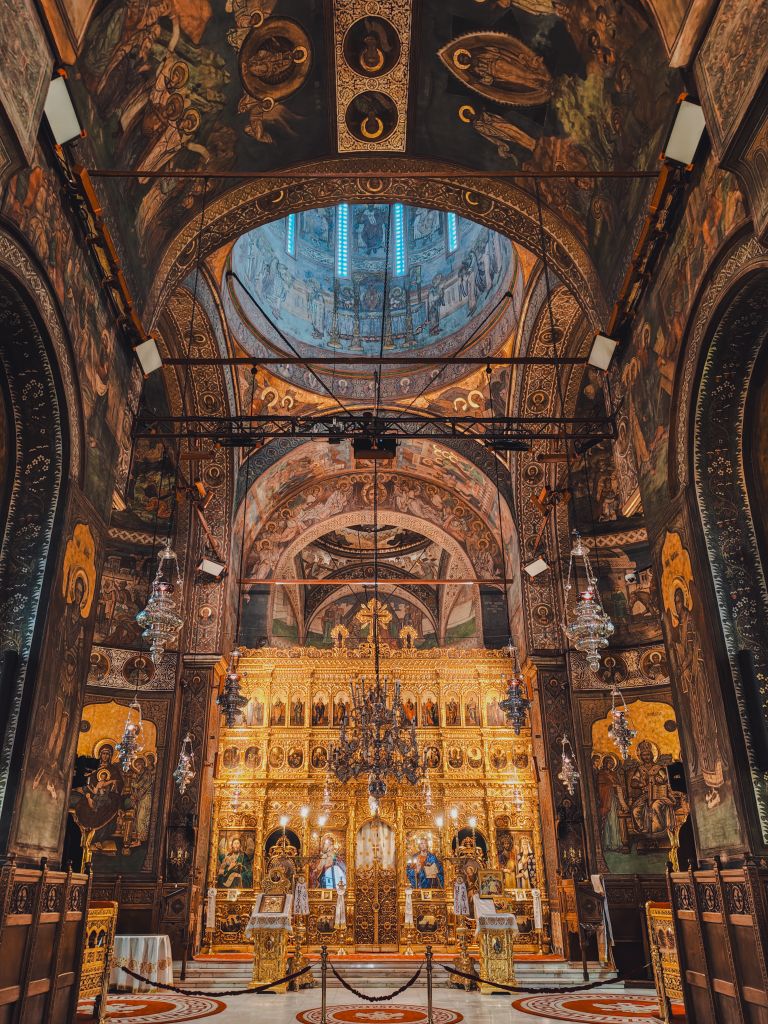
Stavropoleos Church
An 18th-century Orthodox church 5 minutes from Lipscani. Free entry. The carved wooden door is specific and beautiful. The small courtyard has Byzantine-style stone arches with decorative stonework salvaged from demolished churches.
It’s easy to miss in a day of Bucharest sightseeing. It shouldn’t be. Allow 20 minutes.
Caru’ cu Bere
A beer hall from 1879 with neo-Gothic stained glass, carved wooden pillars, and painted ceilings. Clearly tourist-oriented. Also genuinely historic and visually extraordinary.
Order the ciorba de burtă (tripe soup — traditional Romanian, not for everyone) or mici (grilled meat rolls with mustard). Sit in the main hall rather than the side sections. Prices are higher than equivalent food elsewhere in the city; the setting is the point.
Herăstrău Park (King Michael I Park)
Large lakeside park in northern Bucharest, pleasant for an afternoon away from the Old Town intensity. Cafés, rowing boat rental, walking paths. 20 minutes from the centre by metro.
Bucharest Costs in 2026 (RON)
| Item | RON | EUR approx |
|---|---|---|
| Airport train (Henri Coandă to city) | 5.5 RON | ~€1.10 |
| Metro single | ~3 RON | ~€0.60 |
| 24hr tourist card (metro + tram + airport) | 20 RON | ~€4 |
| Uber/Bolt city trip (5km) | ~30 RON | ~€6 |
| Palace of Parliament entry | from 85 RON | ~€17 |
| Mici (street food, grilled meat rolls) | 15-25 RON | ~€3-5 |
| Ciorba (sour soup, local restaurant) | 25-40 RON | ~€5-8 |
| Caru’ cu Bere sit-down meal | 60-120 RON | ~€12-24 |
| Hostel dorm | ~96 RON/night | ~€19 |
| Budget mid-range hotel | ~485 RON/night | ~€97 |
| Budget daily total | ~140-200 RON | ~€28-40 |
What costs as much as Western Europe:
- Specialty coffee in hip cafés: €3-4 (same as Berlin)
- Imported craft beer in Old Town bars: €8-12
- Tourist-trap restaurants on main squares: 30-50% more than identical food 5 minutes away
Day Trips from Bucharest
The main day trips are Dracula-related and genuinely good:
Bran Castle + Peleș Palace + Brașov: The most popular day trip. Bran Castle has the Dracula association (Bram Stoker’s Count was loosely inspired by Vlad the Impaler who may have stayed there briefly — the connection is thinner than the marketing suggests). Peleș Palace is more architecturally remarkable. Brașov’s old town is worth 2-3 hours.
Available as guided tours (GetYourGuide, 9-12 hours, €40-60) or independently by train to Brașov (2.5 hours, ~40 RON/~€8).
Practical Information
Currency: Romanian Leu (RON). NOT euros. ~5 RON = €1.
Schengen: Romania completed full Schengen integration (including land borders) in early 2025. Days in Romania now count toward your 90-day Schengen limit.
Language: Romanian. English widely spoken in central Bucharest and tourist areas.
Safety: US State Department Level 1. Low crime by European capital standards. The scam risks above are the main practical concerns.
Best time: April-October for outdoor café culture. Summer is hot (30°C+). Winter is cold but the city is dramatically less busy and cheaper.
FAQ
Is Bucharest worth visiting?
Yes, Bucharest is worth visiting if you want a city that feels real rather than processed. It is rough in places, architecturally incoherent, and not obviously beautiful, but it is also cheap, lively, and historically extraordinary. The Palace of Parliament, Revolution Square, the Old Town, and Bucharest’s nightlife make two to three days the right amount of time for a first visit.
Is Uber available in Bucharest?
Yes. Uber and Bolt both operate in Bucharest and are usually the easiest way to get around instead of using street taxis. They are especially useful from Gara de Nord, the Old Town, and the airport, where taxi overcharging is more likely. A typical short city ride is inexpensive by Western European standards.
What is the Palace of Parliament?
The Palace of Parliament is Bucharest’s most famous communist-era landmark, built under Nicolae Ceaușescu from 1984 and still used for parliamentary and official functions. Standard adult tour tickets start from 85 RON, and visitors should bring photo ID because security checks are required. Check the official Parliament visitor page before going, because access and tour availability can change when parliamentary business is taking place.
Is Bucharest cheap in 2026?
Yes, Bucharest is still cheap compared with Western Europe. Budget travellers can often manage around €28-40 per day, especially if they use public transport, casual restaurants, and free or low-cost sights. The exceptions are specialty coffee, imported beer in Old Town bars, and tourist-trap restaurants on main squares. For local food, metro rides, and normal city costs, Bucharest remains one of the better-value EU capitals.
Is Romania in the Schengen Area?
Yes. Romania is now a full Schengen member. The European Commission confirms that Romania and Bulgaria became full members of the Schengen Area on January 1, 2025, after checks at internal land borders were lifted. Days spent in Bucharest, Brașov, Cluj, or anywhere else in Romania now count toward the Schengen 90/180-day limit. Check the official European Commission Schengen update before travel.
Related articles:
- Eastern Europe Budget Backpacker Guide 2026
- Schengen vs Non-Schengen Eastern Europe 2026
- Eastern Europe Train Travel Guide 2026
- Eastern Europe Summer Travel Deals 2026
Created by WanderGuide Travel Desk
Practical travel planning, built for independent travellers.
WanderGuide articles are created using official tourism and transport sources, route research, hotel-area checks, cost comparisons, local travel context and practical itinerary planning for first-time and budget-conscious travellers.
Read our editorial approach